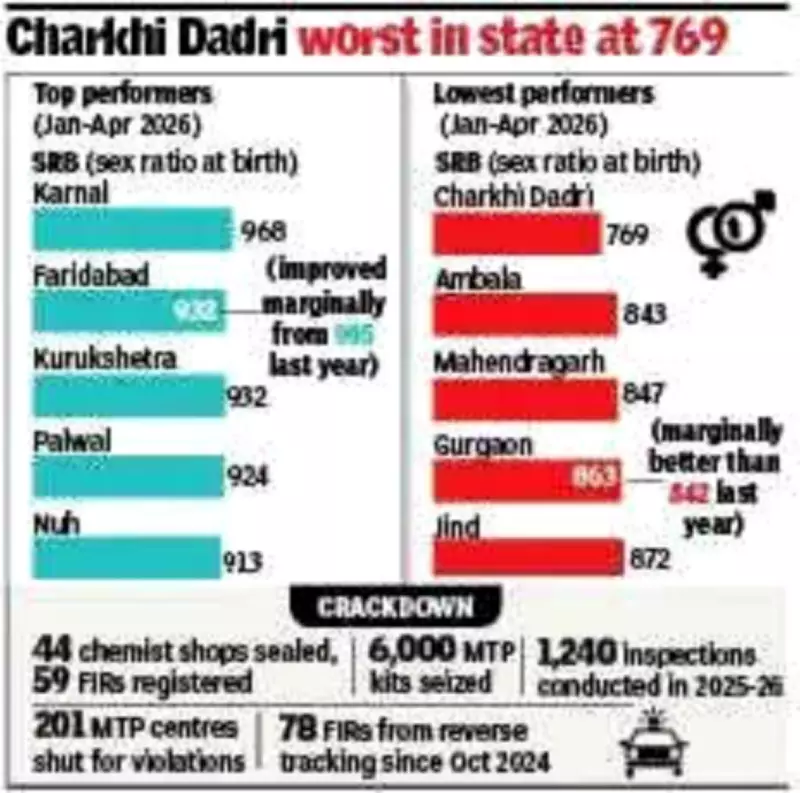
Despite implementing a series of measures to curb suspected gender selection and female foeticide in Haryana last year, the sex ratio at birth (SRB) has declined again in the first four months of 2026, prompting a fresh review by the state government. The SRB for January to April 2026 stood at 895 girls per 1,000 boys, a sharp drop from 925 recorded in the same period last year.
District-Wise Performance
Data reviewed at a meeting chaired by Additional Chief Secretary (Health and Family Welfare) Sumita Misra revealed steep declines in several districts. Charkhi Dadri reported the lowest SRB at 769, followed by Ambala at 843, Mahendragarh at 847, Gurgaon at 863, and Jind at 872. Among the best-performing districts, Karnal recorded the highest SRB at 968, with Faridabad and Kurukshetra at 932 each, Palwal at 924, and Nuh at 913.
Year-on-Year Declines
Several districts saw significant year-on-year drops. Charkhi Dadri's SRB fell from 853 in January-April 2025 to 769 in 2026. Ambala declined from 906 to 843, Jhajjar from 947 to 876, Yamunanagar from 956 to 881, and Panchkula from 966 to 901. Despite being highly urbanised, Gurgaon posted a weak SRB of 863, though slightly better than last year's 842. In contrast, neighbouring Faridabad improved from 905 to 932.

Statewide Context
The decline comes despite Haryana recording its highest-ever annual SRB of 923 in 2025. District-wise annual data for 2025 showed Panchkula leading at 971, followed by Fatehabad at 961, Panipat at 951, and Karnal at 944. The lowest annual SRB was in Rewari at 882, followed by Sonipat at 894 and Gurgaon at 901.
Government Response
Taking serious note of the decline, Misra directed district administrations, police, and health officials to intensify sting operations and dismantle organised interstate networks involved in illegal sex determination and female foeticide. She ordered faster reverse tracking of abortion cases, inspections of medical stores linked to illegal sale of MTP kits, and identification of unauthorised hospitals carrying out unlawful procedures. She warned officials against complacency despite recent gains.
Enforcement Actions
Officials reported that Haryana has 1,206 registered MTP centres, of which 201 have been shut down for violations. Authorities conducted 1,240 inspections during 2025 and 2026, issuing 58 notices to erring centres. Reverse tracking of abortions has been expanded, with over 600 MTP cases involving pregnancies between 12 and 20 weeks tracked between January and March 2026. MTPs below 12 weeks declined from 47,730 in 2024-25 to 43,443 in 2025-26, while cases beyond 12 weeks fell from 4,291 to 3,841.
Crackdowns on illegal sale of abortion kits have intensified, with 44 chemist shops sealed, 59 FIRs registered, and over 6,000 MTP kits seized across Haryana this year. Since 2014, the state has registered more than 1,300 FIRs under the PCPNDT and MTP Acts and conducted over 400 interstate raids against illegal operators.
Community Engagement
Misra instructed officials to strengthen monitoring through the Saheli network of ASHA workers, anganwadi workers, and auxiliary nurse midwives. She said accountability would be fixed in cases of negligence, while good-performing field staff would be recognised. The government has decided to step up village-level awareness campaigns in districts with poor SRB and involve religious leaders and local institutions. Misra suggested that pandits, maulvis, and granthis conducting marriages should encourage couples to pledge against sex determination tests and female foeticide.
Historical Context
Haryana, which had the worst sex ratio at birth among all states at 834 girls per 1,000 boys during the 2011 Census period, improved its SRB to 923 by 2019 after years of aggressive enforcement under the Beti Bachao Beti Padhao campaign. However, the state has since seen a renewed decline, with the annual SRB falling to 910 in 2024, the lowest level since 2016.