

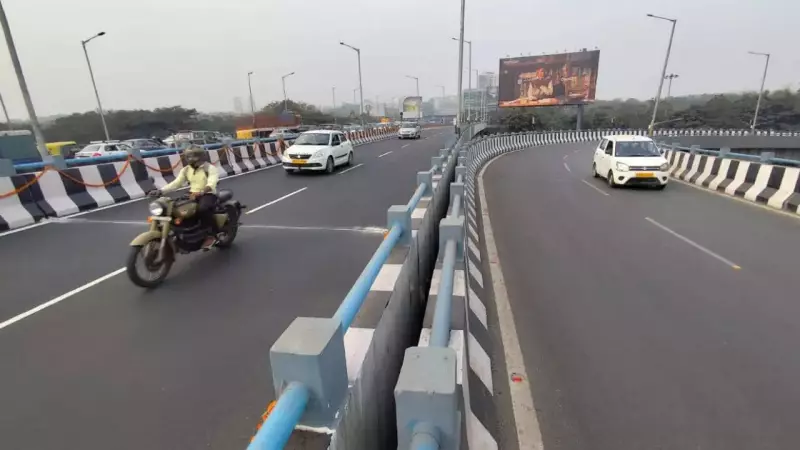
Bengaluru's infamous Hebbal flyover, long synonymous with frustrating gridlock, has undergone a remarkable transformation. A recent test drive during the morning peak hour revealed that a stretch which once took up to 30 minutes to crawl through can now be covered in a mere two minutes, bringing immense relief to thousands of daily commuters.
From Nightmare to Near-Free Flow
The dramatic improvement is credited to newly implemented traffic loops and better lane segregation. During a test conducted on January 7, 2026, a vehicle covered the one-kilometre distance from Esteem Mall to the Hebbal traffic police station in just over two minutes. Two-wheelers were reportedly maintaining speeds of 40 to 60 kilometres per hour on this stretch—a scenario deemed unthinkable just months ago.
Motorists have welcomed the change, noting that the flyover no longer lives up to its dreaded reputation. Many recall the old days when they would pray for traffic police to halt airport-bound vehicles to ease the congestion, a practice that has now become unnecessary.

Key Improvements and Persistent Pinch Points
One of the most significant easements is on the Tumakuru Road loop. Previously, vehicles would wait 10 to 12 minutes just to access the flyover from this point. The new design allows near-seamless movement, greatly benefiting traffic originating from areas like Byataranapura and Kodigehalli.
Authorities state that the smoother flow is a direct result of effective lane segregation. Vehicles coming from the airport, Kodigehalli, and KR Pura now move in independent streams, which has eliminated the need for the stop-and-go regulation that previously choked the flyover.
Congestion Shifts, Not Disappears
However, the relief is not absolute. Residents and commuters have flagged new bottlenecks that have emerged downstream. Areas near Baptist Hospital, the UAS campus bus stop, CBI junction, and Ganganagar are now experiencing fresh snarls. At Baptist Hospital, a BMTC bus stop and vehicles cutting across lanes disrupt the flow, causing commuters to lose the time they saved on the flyover soon after exiting it.
Another persistent pinch point is Mehkri Circle, where vehicles continue to pile up at the underpass. During the same test drive, traffic stalled here for about three minutes, offsetting a portion of the time gained on the flyover itself. This highlights a critical reality: while the flyover itself flows freely, congestion has largely shifted downstream rather than vanished entirely.
A New Chapter for a Notorious Choke Point
The transformation of the Hebbal flyover marks a significant victory in Bengaluru's ongoing battle against traffic chaos. The project demonstrates that well-planned infrastructure interventions can yield dramatic results. Yet, the emergence of new choke points serves as a reminder that holistic traffic management requires continuous assessment and adjustment of the entire network, not just isolated corridors.
For now, commuters who brave the Hebbal stretch daily are breathing easier, celebrating the fact that a journey that was once a test of patience has been reduced to a quick, two-minute glide.






