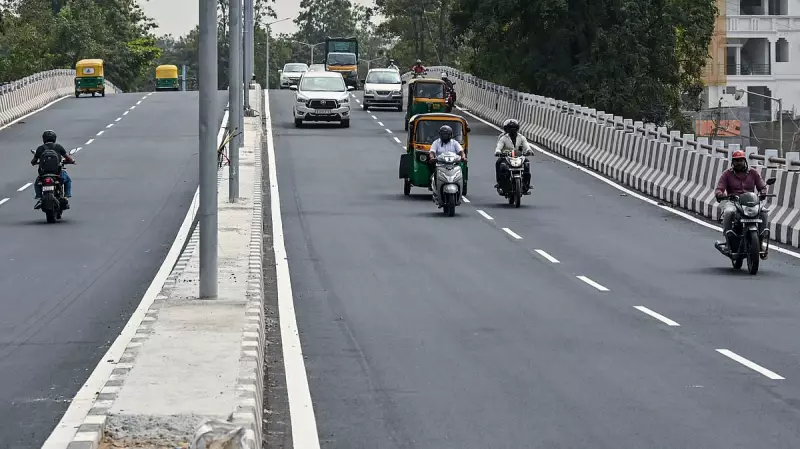
Residents of Bengaluru who had hoped for smoother commutes after the opening of the Hosakerehalli flyover have been left deeply disappointed. The much-anticipated infrastructure project, intended to decongest a critical corridor, is reportedly failing to deliver relief, with severe traffic snarls simply shifting from the ground level to the elevated section.
Flyover Becomes New Bottleneck During Peak Hours
Commuters report that during the morning and evening rush, the flyover heading towards Nayandahalli becomes clogged with vehicles. The promised seamless flow of traffic has not materialized. Instead, the congestion point has been transferred upwards, creating a new aerial bottleneck. This has dashed the hopes of thousands who regularly use this route, expecting the project to cut down their travel time significantly.
"Five-Year Wait for Nothing," Says Frustrated Commuter
The sentiment on the ground is one of frustration and resignation. Ramakanth, a daily commuter, voiced a common grievance, stating, "The flyover has transferred the bottleneck from ground to flyover. There is no actual relief and a five-year waiting period for nothing to change." His comments, made on 03 January 2026, underscore the public's perception of wasted time and resources. The long construction period, which caused its own set of disruptions, now seems to have yielded minimal benefits for peak-hour travelers.

Ongoing Traffic Woes and the Search for Solutions
The situation at Hosakerehalli highlights the persistent and complex challenge of managing Bengaluru's legendary traffic. It raises questions about the planning and predictive modeling for such infrastructure projects. Key issues emerging include:
- Whether traffic volume projections were underestimated.
- If complementary road expansions or traffic management systems are needed.
- The need for integrated multi-modal transport solutions to reduce private vehicle dependency.
The failure of this flyover to provide the expected respite suggests that isolated infrastructure projects, without a holistic approach to urban mobility, may not solve the city's deep-rooted congestion problems. The authorities now face renewed pressure to analyze this specific failure and implement corrective measures to truly unlock the flyover's potential.