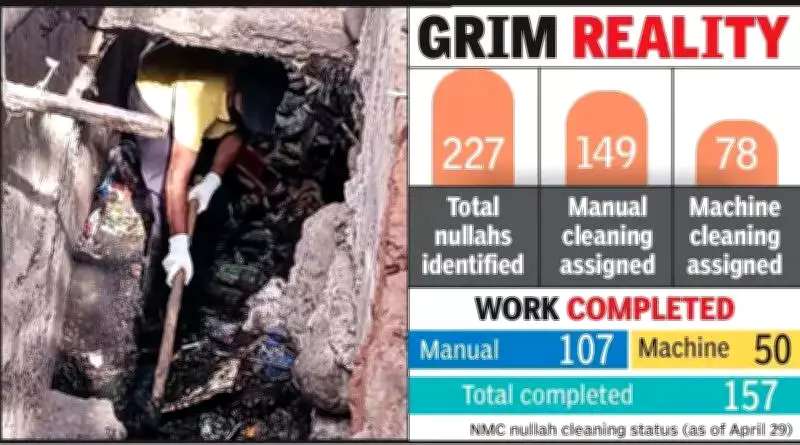
Nagpur: In blatant violation of the ban on manual scavenging, sanitation workers in the city are still being forced to enter filthy, sewerage-choked nullahs and clear waste by hand, as civic records reveal that nearly 65% of drains are being cleaned manually.
Ground visuals from multiple localities show workers wading through toxic sludge without adequate safety gear, exposing a disturbing gap between policy and practice, even as the Nagpur Municipal Corporation claims mechanised cleaning.
Images from Gittikhadan and surrounding localities show sanitation workers wading through knee-deep filth inside cramped drains, manually scooping out waste with bare hands and basic tools. In one instance, workers are seen lifting sludge-filled heaps using sheets of cloth, while another shows a labourer inside a partially covered drain, clearing garbage in suffocating conditions.

Civic Data Reveals Reliance on Manual Labour
The civic body's data reinforces the grim reality. According to the NMC solid waste management department report dated April 29, a total of 227 nullahs across 10 zones were identified for cleaning. Of these, 149 nullahs — over 65% — were assigned for manual cleaning. Of the total work completed so far, 107 nullahs have been cleaned manually, while only 50 were handled using mechanised methods. Another 10 manual cleaning operations are still ongoing, indicating continued reliance on manual scavenging in direct violation of safety norms.
Zones like Gandhibagh (46 manual out of 51), Dharampeth (27 out of 35) and Satranjipura (19 out of 22) reported a disproportionately high number of drains being cleaned manually. Even in zones with available machinery, manual intervention remains the dominant mode.
Legal Violations and Safety Concerns
This comes despite clear directives under the Prohibition of Employment as Manual Scavengers and Their Rehabilitation Act, which bars hazardous manual cleaning of sewers and septic tanks without protective gear and mechanised support.
Ground reports suggest workers are often deployed without adequate safety equipment such as oxygen masks, protective suits or gas detectors, leaving them exposed to toxic fumes and life-threatening infections.
Civic activists have slammed the NMC for what they describe as a 'systemic failure masked by paperwork'. 'The data clearly shows manual cleaning is not an exception but the norm. This is not just negligence — it is a violation of human rights,' said a city-based activist.
Residents too have raised concerns over both the health risks and inefficiency. 'If machines are available, why are workers being forced into drains? It's unsafe for them and ineffective in the long run,' said a resident from Panchsheel Nagar.
When contacted, officials maintained that mechanised cleaning is being prioritised wherever feasible, but admitted that 'in narrow and inaccessible stretches, manual intervention becomes unavoidable'. Critics argue that such justifications have become routine, allowing the banned practice to continue unchecked.
With 45 nullahs still pending cleaning and pre-monsoon preparations underway, the continued dependence on manual labour raises serious questions about worker safety, administrative accountability and the city's preparedness to handle flooding and sanitation challenges.