Ahmedabad's Mega Lotus Garden Project Faces Scrutiny as Costs Skyrocket
Ahmedabad is poised to receive its most expensive public garden to date, a sprawling lotus-shaped complex that will showcase the state flower of every Indian state. However, the project's journey from conception to execution has been marred by significant cost escalations and procedural controversies that have drawn intense public and administrative attention.
From Rs 20 Crore to Rs 120 Crore: A Six-Fold Budget Increase
The Ahmedabad Municipal Corporation (AMC) initially allocated a modest Rs 20 crore for what was then called 'Lotus Park' or 'Garland of India' in its 2024-25 budget, approved by the standing committee on February 6, 2024. The concept envisioned a beautiful lotus-shaped garden where each petal would bloom with a different Indian state's floral emblem. An additional Rs 20 crore followed in the 2025-26 budget, but the project has since undergone dramatic transformations.
The current budget now stands at a staggering Rs 120 crore, representing a six-fold increase from the original allocation. This massive escalation has raised eyebrows among taxpayers and civic observers alike, especially given the project's shifting parameters and location.
Location Shift and Expanded Scope
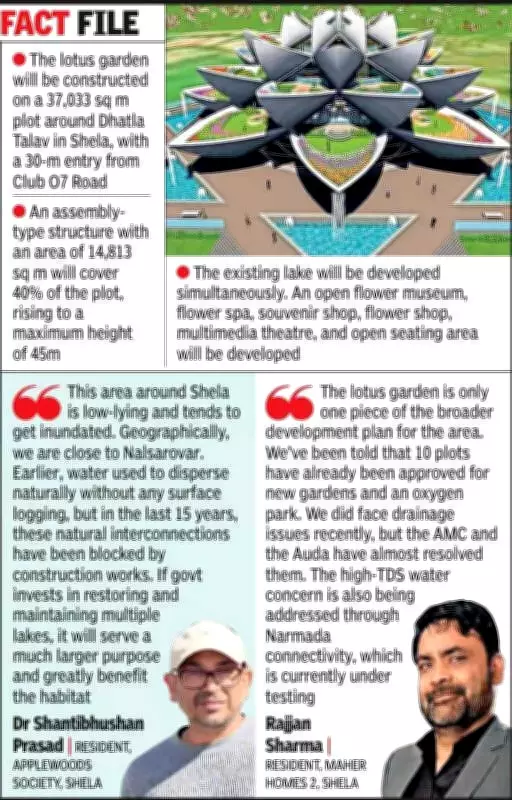
The garden will no longer be built on SG Highway as originally announced. Instead, it will occupy 37,033 square metres of land near Dhatla Talavdi in Shela, with a 30-metre entry from Club O7 Road. The project has also shed its original name while expanding its scope considerably.
The complex will feature an assembly-type structure covering 40% of the plot, rising to a maximum height of 45 metres. Inside, visitors will find a comprehensive flower museum, spa facilities, souvenir shops, a multimedia theatre, and open seating areas. An entry fee will be charged to access these amenities. Additionally, the adjacent plot has been earmarked for a glow garden, transforming the site into a two-attraction destination that promises to become a major recreational hub.
Controversial Appointment and Tendering Processes
The process behind this ambitious project has generated as much discussion as the garden itself. According to reliable sources, "a consultant/architect who was not on the approved panel was appointed for this project without a formal tender process." This is particularly concerning because the AMC typically maintains a panel of consultants for a five-year term to work on various municipal projects.
Furthermore, this consultant was reportedly appointed at a higher fee despite empanelled consultants being available at lower rates, raising questions about procurement transparency and fiscal responsibility.
The construction tendering process has been equally contentious. The first tender was floated on November 14, 2025, with a December 8, 2025 deadline. Only two companies responded, and one failed to qualify technically, forcing a re-tender. The second tender was issued on February 9, 2026, with a February 20 deadline—giving bidders just 12 days to respond to a Rs 120 crore contract. A company that requested an extension during the pre-bid meeting was reportedly turned down, and the return on investment for the project has not been formally verified according to sources.
What Comes Next for the Lotus Garden Project
A proposal to approve the construction is expected to be placed before the upcoming AMC standing committee. The project represents both an ambitious vision for urban beautification and a case study in how municipal projects can evolve—and sometimes devolve—through their planning stages.
As Ahmedabad prepares for this landmark addition to its public spaces, questions remain about the transparency of the selection process, the justification for the massive cost escalation, and whether the final product will deliver value commensurate with its substantial public investment. The lotus garden project has become a symbol of both municipal ambition and the challenges of executing large-scale public works in a transparent, accountable manner.