

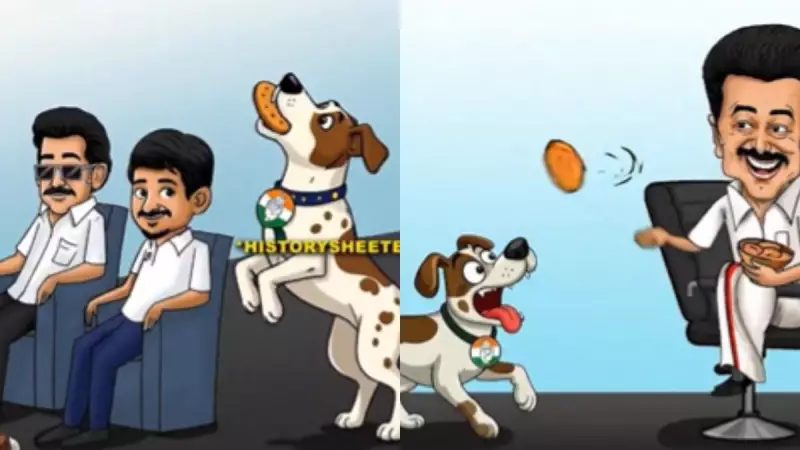
In a scathing verbal attack that has sent ripples through Tamil Nadu's political landscape, senior AIADMK leader D Jayakumar has launched a sharp critique against the Congress party. He derisively labeled the grand old party as a "tail-wagging puppy" of the ruling Dravida Munnetra Kazhagam (DMK). This comment, made on Monday, December 30, 2024, exposes the deepening fissures within the opposition INDIA alliance in the state.
A Blistering Attack on Congress's Autonomy
The criticism was not a casual remark but a pointed political assault. D Jayakumar, a former minister and a prominent voice within the AIADMK, questioned the very independence of the Congress party in Tamil Nadu. He accused Congress leaders of acting merely as cheerleaders for the DMK government, lacking any substantive critique or policy stance of their own.
The core of Jayakumar's argument was that the Congress has surrendered its political voice to its dominant ally, the DMK. He suggested that instead of holding the government accountable, Congress functionaries are preoccupied with praising Chief Minister M K Stalin and his administration. This, according to the AIADMK leader, reduces the Congress to a subservient entity whose sole purpose is to validate the DMK's actions.

Undermining the INDIA Bloc's Unity
This public mockery carries significant weight as it targets a key partner within the INDIA opposition bloc at the national level. While the AIADMK is not part of this alliance, the open ridicule of a major constituent like the Congress highlights the complex and often contradictory dynamics of state versus national politics. The comments are seen as an attempt by the AIADMK to isolate the Congress in Tamil Nadu and question its credibility as an effective opposition force.
Jayakumar's statement implies that the Congress-DMK alliance is not a partnership of equals but one of master and follower. By using the imagery of a "puppy," he aimed to portray the Congress as needy, dependent, and eager to please its master, the DMK. This is a direct challenge to the Congress's claim of being a senior and respected national party with its own legacy in the state.
Political Repercussions and Future Implications
The immediate consequence of this verbal salvo is a likely escalation of political rhetoric in Tamil Nadu. The Congress is now under pressure to respond strongly to defend its honor and political standing. A weak response could cement the narrative of subservience that the AIADMK is trying to build.
Furthermore, this attack complicates the opposition space in the state. For voters dissatisfied with the DMK government, the AIADMK is positioning itself as the only genuine, uncompromising opposition. By mocking the Congress, the AIADMK seeks to delegitimize it as an alternative and consolidate the anti-incumbency vote in its own favor.
The incident also poses an awkward situation for the DMK. While it may privately enjoy seeing its ally being attacked by a common foe, it cannot openly endorse such remarks. The DMK leadership will have to walk a tightrope, maintaining its alliance with the Congress for national objectives while navigating the AIADMK's aggressive state-level campaign.
In conclusion, D Jayakumar's harsh characterization of the Congress is more than just political name-calling. It is a strategic move to redefine opposition politics in Tamil Nadu, undermine a rival, and position the AIADMK as the sole credible challenger to the DMK regime. The coming days will reveal how the Congress and the DMK choose to counter this narrative and whether this marks a permanent souring of relations between the AIADMK and the Congress on the ground.






