

Andhra Pradesh's Fertility Crisis: Economic Pressures Drive Youth Away From Marriage, Children
In the bustling urban centers of Andhra Pradesh, a quiet but profound societal shift is underway. Young people across the state are increasingly hesitant about marriage and parenthood, driven by a perfect storm of economic uncertainty, career pressures, and rising living costs. This trend is reshaping family structures and raising alarms about the state's future demographic balance.
The Numbers Tell a Stark Story
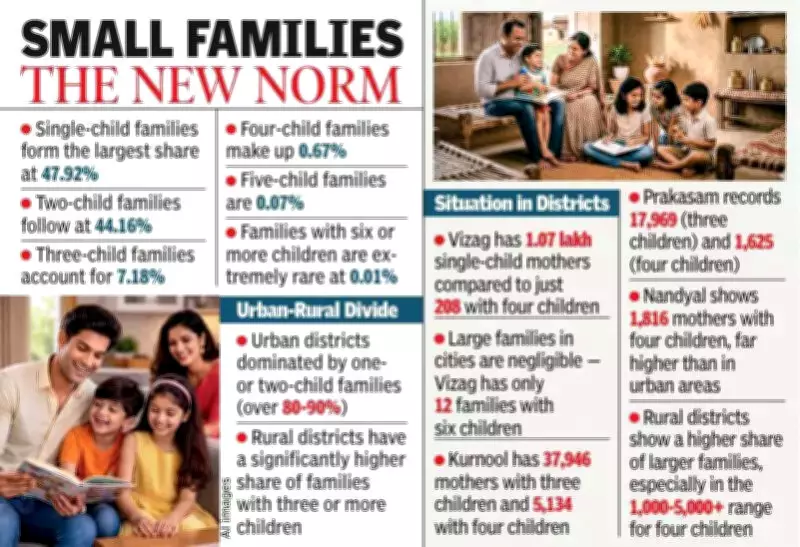
Recent data reveals a clear movement toward smaller family sizes in Andhra Pradesh. Approximately 48% of mothers have only one child, while 44.16% have two children. A mere 7% of mothers have three or more children, indicating that the traditional larger family model is becoming increasingly rare.
This shift is reflected in the state's fertility rate, which has plummeted to 1.5 children per woman – significantly below the replacement level of 2.1 needed to maintain a stable population. The decline has been dramatic and steady, dropping from 3.0 in 1992 to 2.2 in 2002, and now to its current low of 1.5.

Urban-Rural Divide in Family Planning
The trend toward smaller families is particularly pronounced in urban areas, where economic pressures are most acute. Districts such as Visakhapatnam, Krishna, and Guntur show higher concentrations of one-child families, reflecting the realities of urban living where:
- Cost of living is substantially higher
- Dual-income households leave little time for parenting
- Career aspirations compete with family priorities
- Lifestyle expectations demand significant financial resources
In contrast, more rural and tribal districts including Kurnool, Nandyal, and Alluri Sitharama Raju (ASR) maintain relatively higher fertility levels, with more families having three or more children. This urban-rural divide highlights how economic development and urbanization are reshaping family planning decisions across the state.
Multiple Factors Driving the Change
Several interconnected factors are contributing to this demographic transformation:
- Economic Uncertainty: Ongoing layoffs at leading companies and uncertainty about future job markets are making young people cautious about long-term commitments like marriage and children.
- Rising Costs: Soaring education and healthcare expenses are making child-rearing increasingly expensive, particularly in urban areas.
- Career Priorities: The growing emphasis on education and professional advancement is leading to later marriages and delayed childbirth.
- Lifestyle Pressures: The desire to maintain certain living standards and the demands of modern urban life are competing with traditional family aspirations.
Medical Professionals Observe the Trend
Healthcare providers in Andhra Pradesh are witnessing these changes firsthand. Dr. K. Rambabu, Director of Visakhapatnam Institute of Medical Sciences (VIMS), notes that there has been a growing trend of couples choosing not to have children at all.
"We are increasingly counselling such couples to consider starting a family and informing them about the medical and social implications of delayed or absent parenthood," Dr. Rambabu explained.
Dr. Santhosh Kumar Routhu, Chief Intensivist and Head of the Department of Paediatric Intensive Care at KIMS Cuddles in Visakhapatnam, observes that career and education priorities are fundamentally altering family planning decisions.
"People feel they can provide more time, attention, and financial security if they have one or two children rather than more. The one- or two-child norm has clearly become the social standard," Dr. Routhu noted.
State Response and Future Implications
Andhra Pradesh, which has long highlighted its young population as a key strength, is now encouraging couples to have more children in response to concerns about future demographic balance. However, experts question whether this push will be successful given the powerful economic forces driving current trends.

The critical question remains: Will Andhra Pradesh's demographic shift translate into a demographic dividend that drives economic growth, or will it become a demographic challenge if stable employment opportunities and social support systems fail to keep pace with rising aspirations and economic realities?
As young people navigate the complex intersection of career ambitions, economic pressures, and family aspirations, their decisions today will shape Andhra Pradesh's social and economic landscape for decades to come. The state's response to this fertility crisis – through policy interventions, economic support, and social programs – will determine whether it can maintain a healthy demographic balance while supporting the aspirations of its youth.





