Assam's 2026 Assembly Elections Create Democratic History with Record Turnout
Guwahati: The 2026 assembly elections in Assam have dramatically rewritten the state's democratic narrative, achieving an unprecedented voter turnout of 85.5%. This remarkable participation rate represents the highest recorded since the inaugural polls in 1951, as thousands of determined citizens braved persistent rainfall to cast their ballots across the northeastern state.
Election Commission Reports and Peaceful Polling
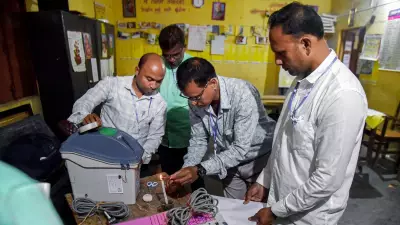
The Election Commission has indicated that the final polling percentage may increase further once tabulation from remote booths concludes on Friday morning. The electoral process remained largely peaceful across all 126 constituencies, with only isolated incidents of group clashes reported in Patharkandi constituency within Sribhumi district and Khowang in Dibrugarh district, resulting in approximately 30 injuries.
Technical issues emerged at a few polling stations where EVM malfunctions temporarily interrupted voting procedures. Additionally, a polling official passed away before voting commenced in Naduar constituency of Sonitpur district, with authorities suggesting the death was likely due to pre-existing health conditions.

Voter Enthusiasm Defies Weather Challenges
Despite steady downpours, enthusiastic voters formed queues from early morning at numerous polling booths. Many women arrived dressed in vibrant traditional attire, demonstrating their commitment to democratic participation. First-time voter Irina Saikia, waiting outside MDKG College polling station in Dibrugarh with a dripping umbrella but buoyant spirits, declared: "I have been anticipating this day since turning 18. A little rain could never deter me. Whether it rains or shines, we demand improved roads, employment opportunities, and better education. This marks my inaugural vote, and I was determined to ensure my voice resonates."
Political Reactions and Historical Context
This election surpasses the previous record of 84.6% turnout established in 2016, when the BJP formed its first government in Assam, ending the Congress party's three-term uninterrupted rule. Political leaders swiftly capitalized on the extraordinary participation to shape their narratives.
Chief Minister Himanta Biswa Sarma celebrated the turnout as "not ordinary but historic," characterizing the election as a movement to safeguard Assam's civilizational values, cultural heritage, and territorial integrity. Expressing confidence about the results, Sarma predicted: "We anticipate securing 90-plus seats, and reaching 100 would not be surprising. We will also capture two minority seats. The AIUDF might obtain four to five seats, Congress 18 to 22, leaving the opposition with approximately 36 seats if we achieve 90."
Describing this as a watershed moment, Sarma asserted that citizens voted with determination to protect their land, identity, and culture from illegal infiltration and demographic pressures.
Regional and Opposition Perspectives
BPF president and Bodoland Territorial Council chief Hagrama Mohilary projected a "clean sweep by NDA across all 15 seats within BTC," highlighting the ruling alliance's confidence in its traditional stronghold.
Conversely, Congress state president Gaurav Gogoi, contesting from Jorhat, expressed gratitude to voters for turning out in substantial numbers to support transformation toward a "New Bor Asom" (New and Greater Assam). He urged the Election Commission to guarantee EVM security and accurate counting scheduled for May 4.
Demographic Voting Patterns and Regional Variations
Assam Chief Electoral Officer Anurag Goel noted that voter enthusiasm remained undiminished despite inclement weather in certain regions. He expressed appreciation for the people of Assam's active engagement, stating: "The substantial presence of citizens at designated locations even after 5 PM reflects public awareness and enthusiasm toward voting."
Muslim-majority constituencies historically drive turnout surges, with Dalgaon constituency in Darrang district recording the highest participation at 94.5%. Fifteen additional constituencies where Muslim voters are decisive recorded turnouts exceeding 90%.

The Hindu belt in upper Assam's eastern region recorded an overall turnout of 82%, below both the state average and representing a one-point decline from 2021. However, Nazira (84.7%) and Majuli (83.6%) demonstrated strong performance within this region.
Industrial centers including Dibrugarh (77.9%), Tinsukia (77.7%), and Jorhat (77.9%) lowered the belt's averages. The Bodoland heartland averaged 85%, with Parbatjhora (90.4%) and Baokhungri (87.7%) leading, while the north bank remained strong at 84.1%.
Barak Valley concluded at 82.9%, with Karimganj North achieving the highest at 84.5%. Hill districts proved the weakest link as Karbi Anglong and Dima Hasao averaged 74.2%, the state's lowest, primarily due to challenging terrain, logistical obstacles, and political disengagement.
Guwahati, the largest urban center, saw its five constituencies average 76.3%, slightly above hill districts. Chief Minister Himanta Biswa Sarma's Jalukubari constituency recorded the city's highest turnout at 80.8%.