

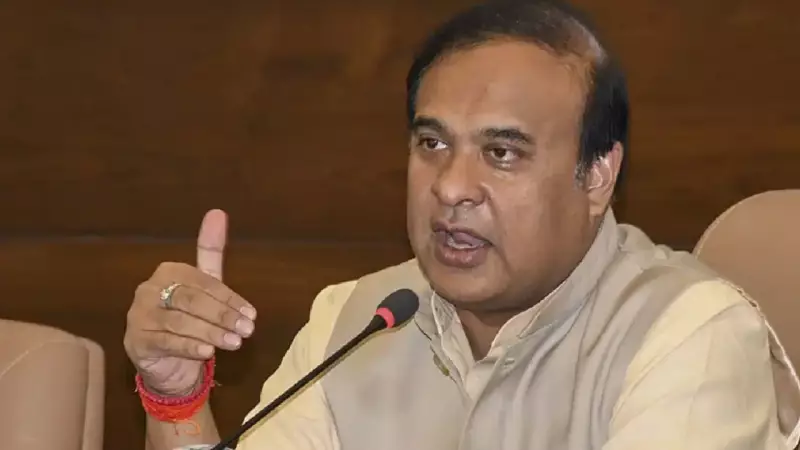
In a stark revelation about Assam's economic landscape, Chief Minister Himanta Biswa Sarma has highlighted the state's heavy reliance on imports for everyday essentials. He disclosed that a staggering 90% of daily-use products consumed in Assam are procured from other Indian states.
A Call for Self-Sufficiency at Dibrugarh Event
The Chief Minister made these remarks on Sunday while distributing seed money of Rs 10,000 to each member of women's self-help groups (SHGs). The event took place at the Dinjoy Tea Estate in Chabua, located in the Dibrugarh district.
CM Sarma expressed deep concern over the financial outflow, stating that for every Rs 100 earned through business activities in Assam, a substantial Rs 80 leaves the state to pay for goods produced elsewhere. This, he emphasized, underscores a critical need for building internal production capabilities.

The Dairy Deficit: A Case Study in Dependency
To illustrate the scale of the problem, Sarma provided a compelling example from the dairy sector. He revealed that Assam's daily milk requirement stands at 25 lakh litres. However, the state's own production meets only 3 lakh litres of this demand.
The massive deficit of 22 lakh litres is bridged by purchasing milk from states like Bihar, Gujarat, and Karnataka. The CM pointed out that women entrepreneurs in Gujarat and Karnataka have successfully built thriving dairy economies, a model he believes Assam can and must replicate.
Empowering SHGs: The Path to Economic Independence
Chief Minister Sarma positioned the state's women's self-help groups as the organized force that can spearhead this economic transformation. He asserted that if every SHG member actively engages in production activities, these groups can achieve self-sufficiency and financial independence.
The distribution of seed money is a strategic step to catalyze this shift from consumption to production. The vision is to empower local communities, especially women, to start manufacturing goods that Assam currently imports, thereby retaining wealth within the state and creating sustainable livelihoods.
The CM's statements serve as a clarion call to reduce Assam's external economic dependency by fostering a robust culture of local entrepreneurship and production, with women-led collectives at the forefront of this change.






