

Bengaluru Metro Fare Revision Sparks Political Confrontation
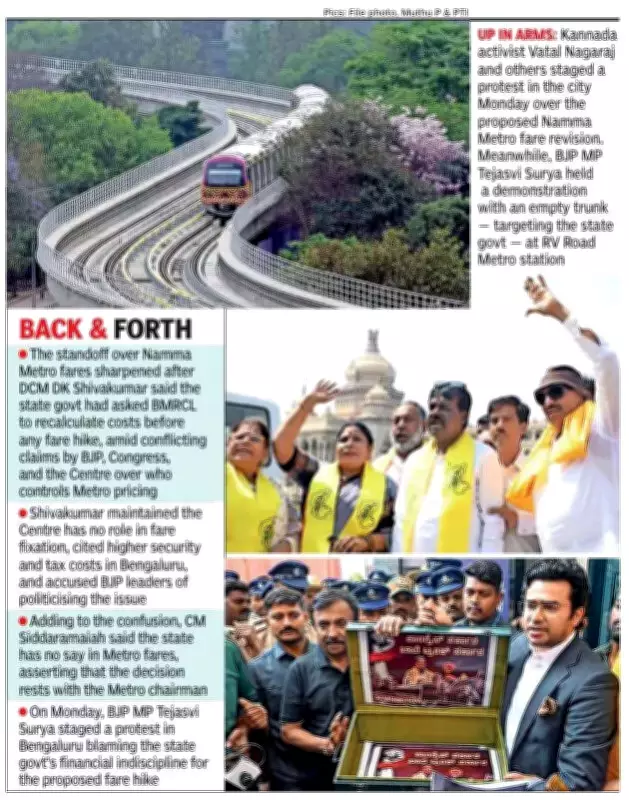
The political battle over Namma Metro fares escalated dramatically on Monday as Deputy Chief Minister DK Shivakumar announced the state government has directed the Bangalore Metro Rail Corporation Ltd (BMRCL) to recalculate all operational costs before implementing any fare adjustments. This directive came just as contradictory claims emerged from various political factions including the BJP, Congress, and central government representatives regarding who ultimately controls Metro pricing decisions.
State Government Takes Charge of Fare Review
Clarifying that the Union government plays no role in the fare revision process, Shivakumar revealed that during a meeting with officials including BMRCL representatives, a decision was made to thoroughly reassess all operational expenditures. "BMRCL had announced an annual fare revision based on recommendations from the Fare Fixation Committee (FFC) provided last year," explained Shivakumar, who also holds the Bengaluru development portfolio. "Metro fares were previously revised and made effective from February 9 last year, and the committee has recommended revising fares annually by up to 5%."
"Based on the FFC recommendation, BMRCL proposed to revise the fares with effect from Monday, February 9. However, I have personally directed BMRCL to recalculate everything and present a revised fare structure. The final amount may decrease or remain unchanged after this comprehensive recalculation," he emphasized.

Comparative Analysis with Delhi Metro
Addressing claims that Metro fares in Bengaluru exceed those in other Indian cities, Shivakumar argued that any comparison with Delhi must account for significant security and taxation differences. "In Delhi, the Central Industrial Security Force (CISF) manages security operations and Goods and Services Tax is not applicable. In Bengaluru, BMRCL bears substantial security costs independently," he noted, highlighting the financial burden shouldered by the Bengaluru Metro system.
Shivakumar further disclosed that BJP leaders had initially demanded a fare hike until the next board meeting, but the scheduled Monday meeting was unexpectedly postponed without any conclusive decision. "The board meeting was called off after the Union government realized it could not intervene without constituting a new Fare Fixation Committee," he stated.
Political Credit and Allegations
Responding to BJP claims taking credit for the suspension of the fare increase, Shivakumar asserted, "I am not seeking personal credit for this decision. The central government has no role or authority in this matter. This is exclusively a state government decision, and we remain committed to making choices that serve the public interest." He additionally alleged that BJP members and some Members of Parliament were deliberately politicizing the issue for electoral gains.
The Deputy Chief Minister provided financial context, revealing that the state government had allocated Rs 1,064 crore to compensate for operational losses and paid Rs 4,002 crore to the central government toward loan repayment obligations.
Contradictory Statements from State Leadership
In a surprising development from Davanagere, Chief Minister Siddaramaiah appeared to contradict his deputy's position, stating that the state government actually has no role in determining Metro fares and that this authority rests solely with the Metro chairman appointed by the central government. This conflicting narrative from within the state administration added another layer of complexity to the ongoing dispute.
Protest and Political Theater
On Monday, Bangalore South MP Tejasvi Surya arrived at RV Road Metro station carrying an empty trunk adorned with a sticker reading: "Congress Sarkara, Khali Trunk Sarkara" (Congress Government, Empty Trunk Government). The trunk also displayed images of both the Chief Minister and Deputy Chief Minister.
Mocking the state government's position, Surya alleged that the proposed fare hike followed direct communication from state officials to the Fare Fixation Committee stating that an increase was necessary to reduce the government's financial burden. Accusing the state of excessive spending on guarantee schemes, he claimed this had resulted in the withdrawal of "shadow financial support" to BMRCL.

"This financial pressure," Surya alleged, "forced the Metro operator to seek a substantial fare hike through the FFC to offset mounting operational losses." Police intervened, preventing Surya, Jayanagar MLA CK Ramamurthy, and accompanying supporters from entering the Metro station premises. The group was briefly detained before being released.
Surya reiterated his position that the Namma Metro fare revision was suspended only after direct intervention by Union Housing and Urban Affairs Minister Manohar Lal Khattar.
Board Meeting Cancellation and Uncertainty
A scheduled board meeting of BMRCL, planned for Monday, was officially cancelled following instructions from the Ministry of Housing and Urban Affairs (MoHUA). On Sunday, BMRCL had announced that the proposed annual 5% fare revision, scheduled to take effect from Monday, was being postponed until further notice. The corporation stated that any decision regarding revised fares would be communicated only after a comprehensive board review.
Sources familiar with the situation confirmed that the board meeting was indeed scheduled for Monday but was cancelled following communication from the Union government. "The specific reason for cancelling the meeting remains unclear, and there is no definite timeline for when the next meeting might be convened," revealed one source. The BMRCL board is chaired by the Secretary of MoHUA and includes representatives from both Union and state governments, creating an inherent structural tension in decision-making authority.
The suspension of the fare hike has created significant uncertainty for daily commuters while exposing deep political divisions between state and central authorities regarding transportation policy and financial management of critical urban infrastructure projects.





