Bhowanipore Assembly Constituency Sees Drastic Voter Roll Reduction After Special Revision
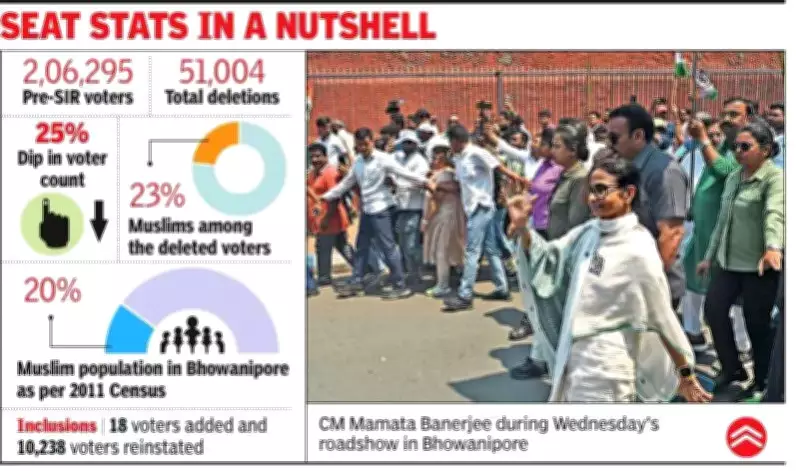
In a significant electoral development, the Bhowanipore assembly constituency in Kolkata has experienced a sharp decline in its voter base, with the electorate shrinking by nearly 25% following the Special Intensive Revision (SIR) process. This high-profile seat, where Chief Minister Mamata Banerjee is contesting against BJP's Suvendu Adhikari, witnessed a total of 51,004 names deleted from the rolls, raising questions about voter demographics and electoral integrity.
Detailed Breakdown of Voter Deletions and Adjudications
Prior to the SIR, Bhowanipore had 206,295 registered voters. The revision process unfolded in multiple phases, leading to substantial changes:
- In the initial phase, 44,787 names were removed under categories such as absent, shifted, deceased, duplicate, or unmapped voters.
- A subsequent round resulted in an additional 2,342 deletions, while only 18 new voters were added to the rolls.
- Approximately 14,154 voters were placed under adjudication, pending further verification, according to official sources.
Researchers from the Sabar Institute, including Ashin Chakraborty, Souptik Halder, and Sabir Ahamed, conducted an in-depth analysis of 15 supplementary lists. Their findings revealed that 10,238 voters initially marked under adjudication were later reinstated, while 3,875 were permanently deleted. Chakraborty highlighted that among those deleted on the supplementary lists, nearly 40% are Muslims, indicating a disproportionate impact on this community.

Disproportionate Impact on Muslim Voters and Final Roll Adjustments
Election Commission sources confirmed that around 3,500 names were deleted during the judicial adjudication process. An official noted, "The constituency has seen a reduction of over 50,000 voters compared to pre-SIR figures. Nearly 14,000 cases were marked under adjudication in the chief minister's constituency."
Chakraborty further pointed out that in the final voter roll, about 56.7% of those flagged as 'under adjudication' were Muslims. This figure is significantly higher than their estimated 20% share of the population as per the 2011 Census. He stated, "Although the share of Muslims among deletions on supplementary lists has come down to around 40%, it remains disproportionately high."
The institute's analysis also showed that 43.4% of non-Muslims were placed under adjudication. Ultimately, 7.7% of Muslims were deleted from the final rolls, compared to 92.3% of non-Muslims, underscoring a stark disparity in outcomes.
Category-Wise Analysis and Broader Electoral Context
Earlier data indicated that Muslims accounted for 22.7% of voters marked as 'Absent, Shifted, Dead/Duplicate' (ASDD), while their share among 'unmapped' voters was around 26%, broadly aligning with their population proportion. However, in the 'logical discrepancy' category, their share rose sharply to 52%, suggesting potential issues in data handling or verification processes.
Despite the deletions, there is a silver lining. Ahamed commented, "Given the awareness about voting rights, support from local political activists, and accessibility for fresh applications, we are also seeing significant new enrolments and reinstatements." This indicates ongoing efforts to balance the voter rolls and ensure inclusivity.
The overall reduction in Bhowanipore's electorate, from over 206,000 to approximately 155,000 voters, marks a pivotal shift ahead of the upcoming elections. With 23.3% of deletions being Muslims and 76.7% non-Muslims, the revision has sparked discussions on demographic representation and electoral fairness in this crucial constituency.