

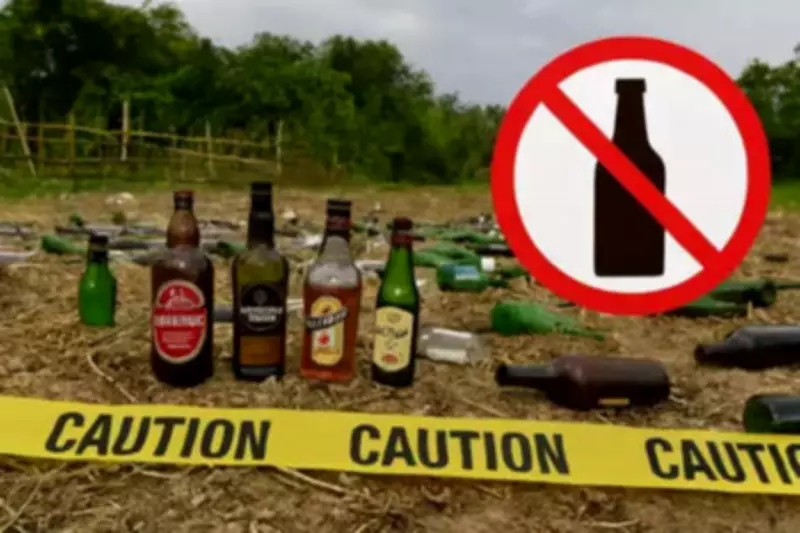
Bihar's Prohibition Policy Enters Critical Phase Amid Growing Political Dissent
Nearly a decade after prohibition was imposed in Bihar during April 2016, the politics surrounding this contentious policy has entered a significantly sharper and more complex phase. Renewed demands for comprehensive review are emerging from various political quarters, even as the state government signals firm continuity with the existing framework.
From Social Reform to Administrative Challenge
What began as a flagship social reform initiative under former Chief Minister Nitish Kumar is now being rigorously tested against harsh administrative realities, mounting economic pressures, and a growing chorus of political voices questioning its overall impact and effectiveness. The latest round of political statements reflects a clear pattern of periodic dissent that now cuts across traditional party lines and ideological boundaries.
While earlier objections to the prohibition policy were often cautious, limited, or expressed in guarded terms, recent interventions suggest a widening political space for more direct and candid articulation on this sensitive issue. This shift indicates changing political dynamics and evolving public sentiment regarding the decade-long experiment with complete prohibition.

Government's Firm Stance Amid Internal Pressure
Amid this significant political churn, Chief Minister Samrat Choudhary made his position unequivocally clear last week, stating that the government remains firmly committed to the prohibition policy without any inclination toward dilution or scrapping. "Prime Minister Narendra Modi and former Chief Minister Nitish Kumar continue to support this policy. In fact, the Prime Minister specifically stated during his Patna visit that prohibition represented the best decision taken by Nitish Kumar during his tenure as Chief Minister," Samrat declared while addressing a public meeting.
The Chief Minister added a crucial qualification to his statement, emphasizing that "we will intensify our crackdown on illegal liquor trade, particularly focusing on spurious liquor that has caused several tragic hooch incidents in recent years." This nuanced position acknowledges enforcement challenges while maintaining ideological commitment to the prohibition framework.
Growing Dissent Within Ruling Ecosystem
Samrat's assertive statement comes at a particularly significant moment when pressure has begun building from within the ruling political ecosystem itself. Rashtriya Lok Morcha MLA Madhaw Anand met with the Chief Minister on April 16, formally seeking a comprehensive review of the prohibition policy. Anand argued persuasively that the policy's current form has led to numerous unintended consequences, including the alarming increase in drug use among youth populations.
The MLA suggested that substantial revenue generated from potentially lifting the prohibition could be strategically channeled into various development activities and public welfare programs. Merely a day later, JD(U) MLA Anant Singh added his voice to the growing chorus, demanding outright scrapping of the prohibition policy. These interventions prove particularly significant as they highlight an emerging gap between the official government position and ground-level perceptions regarding the policy's practical effectiveness and social impact.
Long-Standing Concerns About Social and Economic Fallout
On April 19, Union Minister and Hindustani Awam Morcha (Secular) founder Jitan Ram Manjhi reiterated his long-standing concerns about prohibition, focusing specifically on its profound social and economic consequences. Manjhi revealed that approximately 4.5 lakh individuals, predominantly from economically disadvantaged sections, have faced arrest under various prohibition laws, while more affluent groups continue accessing liquor through sophisticated smuggling networks.

Referring to the grave dangers posed by illicit liquor production, Manjhi explained that "spurious liquor is often prepared within two hours by mixing urea fertilizer," a dangerous concoction that frequently leads to fatalities and serious health complications among consumers. Expressing cautious optimism, Manjhi stated, "Samrat Choudhary has recently taken charge as Chief Minister. In the near future, I genuinely hope that he will definitely review this policy with fresh perspective."
Broader Critique of Implementation Challenges
These statements collectively reflect a broader strand of political opinion that argues while the original intent behind prohibition may have been socially progressive and well-meaning, its practical implementation has created parallel challenges that demand urgent attention. Critics point to several systemic issues:
- Proliferation of sophisticated illegal liquor trade networks
- Significant enforcement burden on already stretched police resources
- Substantial revenue loss for a perpetually cash-strapped state exchequer
- Disproportionate impact on economically vulnerable populations
- Emergence of dangerous spurious liquor alternatives
Evolution of Political Opposition Through the Years
The political history of opposition to Bihar's prohibition policy reveals how this issue has evolved significantly over time. The first major political challenge emerged in December 2017 when Jitan Ram Manjhi initially raised objections, even citing specific cultural practices linked to his community. In December 2020, Congress Legislature Party leader Ajeet Sharma formally wrote to the Chief Minister seeking complete scrapping of the prohibition policy, suggesting potential revenue could be diverted toward industrial development initiatives.
The prohibition issue resurfaced prominently during the Kurhani bypoll in 2022, where it became a significant factor in political mobilization and campaign rhetoric. The debate gained fresh traction during the recent budget session and subsequent political developments, indicating that prohibition remains a live political issue with substantial electoral implications.
Balancing Moral Commitment with Practical Realities
Despite these recurring waves of political dissent, the core position of the ruling dispensation has remained largely unchanged through multiple administrations. The prohibition policy continues to be framed primarily as a moral and social commitment, particularly emphasizing its perceived benefits for women, children, and economically vulnerable sections of society.
Simultaneously, there are clear indications that even within supporting political parties, there exists quiet acknowledgement of the urgent need to address the policy's numerous operational challenges and implementation shortcomings. This creates a complex political dynamic where public endorsement of prohibition's principles coexists with private concerns about its practical execution.
The Shifting Nature of the Prohibition Debate
Currently, Bihar finds itself delicately balancing between continued public endorsement of prohibition's social objectives and an increasingly audible undercurrent of political and administrative questioning. With political voices growing more candid and direct in their criticism, the fundamental debate appears to be shifting significantly.
The central question is no longer merely whether prohibition should exist in principle, but rather how sustainable its present form remains given the practical challenges that have emerged over nearly a decade of implementation. As political voices grow increasingly vocal, the coming months will likely determine whether Bihar's prohibition experiment undergoes substantial modification or continues in its current form despite mounting criticism.





