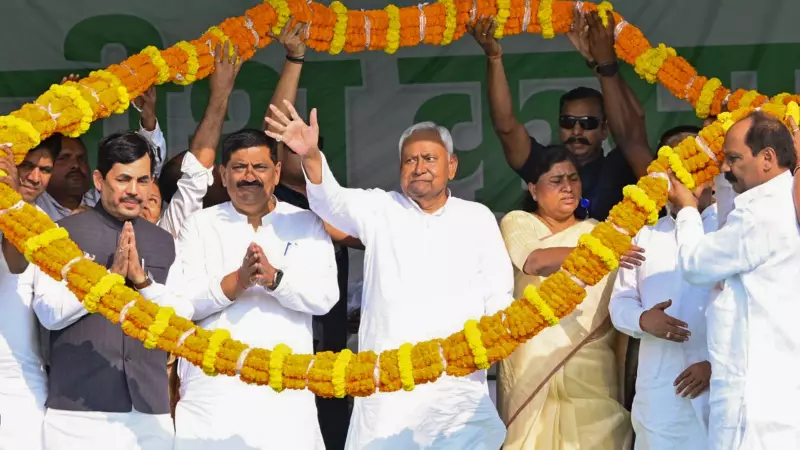
Bihar's Remarkable Journey: From Laggard to Catching Up
As Bihar Chief Minister Nitish Kumar completes nearly two decades in power, an examination of socio-economic data reveals a state that has been rapidly closing the gap with national averages, despite starting from an extremely disadvantaged position. Since assuming office in 2005, Kumar's tenure has witnessed accelerated progress across multiple development parameters.
The data from National Family Health Survey (NFHS) between 2005-06 and 2019-21 demonstrates that Bihar has consistently outperformed the national growth rate on crucial indicators including electricity access, sanitation, education, and healthcare. This progress comes at a significant political moment, with elections looming that many consider could be Kumar's last campaign.
Electricity Access: The Brightest Success Story
One of the most dramatic transformations has occurred in household electrification. In 2005-06, only 25% of Bihar households had electricity access, compared to the national average of approximately 66%. By 2019-21, this gap had nearly vanished, with 96% of Bihar households reporting electricity as their main lighting source versus 97% nationally.

This represents a staggering 250% growth rate for Bihar compared to a 42% increase at the all-India level. While this achievement reflects both Bihar's low starting point and aggressive rural electrification efforts, experts note that the data measures basic access rather than quality or reliability of power supply.
Sanitation and Water: Steady Progress Amid Challenges
The sanitation sector shows similar patterns of rapid improvement. Access to improved sanitation facilities—including sewer-connected toilets, septic tanks, and covered pit systems—grew from 15% in 2005-06 to nearly 50% by 2019-21. During the same period, national coverage increased from 30% to over 70%.
While Bihar's growth rate exceeded the national average, the state still trails significantly in actual coverage. The drinking water scenario presents an even starker picture, with only 9% of Bihar households having piped water access by 2019-21, compared to 33% nationally. The overwhelming majority (83%) still depend on tubewells or boreholes for their water needs.
Women's Education and Healthcare: Focused Interventions Pay Dividends
Nitish Kumar's focus on women's welfare programs appears to have yielded significant results. The percentage of women with more than 10 years of schooling surged from a minimal base to 29% by 2019-21, representing a 3.5-fold increase. Nationally, the figure stands at 41%, but growth has been slower.
One of Kumar's earliest and most visible initiatives, the Mukhyamantri Balika Cycle Yojana launched in 2006, provided free bicycles to school-going girls and symbolized this educational push.
Healthcare infrastructure shows perhaps the most dramatic improvement. Institutional births increased from just 22% in 2005-06 to 76% in 2019-21—a more than threefold expansion. While India overall achieved 89% institutional births during the same period, Bihar's growth rate significantly outpaced the national average.
The Reality Check: Persistent Challenges Remain
Despite these impressive gains, Bihar continues to face substantial development challenges. According to NITI Aayog's Multidimensional Poverty Index, 33.76% of Bihar's population remains multidimensionally poor, more than double the national average of 15%.
Economists caution that while percentage growth figures appear impressive, they must be viewed in context of Bihar's extremely low starting point. The state had significantly more room for improvement compared to other Indian states, and it still ranks as India's poorest state by most measures.
As political attention turns to upcoming elections, the development narrative under Nitish Kumar presents a complex picture: undeniable progress on multiple fronts, yet persistent challenges that continue to keep Bihar at the bottom of national rankings on several socio-economic parameters.