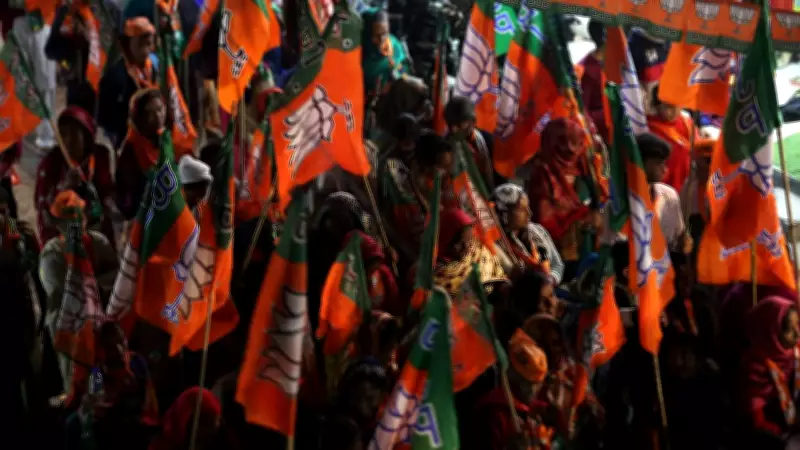
BJP Clinches Chandrapur Mayoral Post in Tense Political Battle
In a dramatic turn of events, the Bharatiya Janata Party (BJP) managed to secure the mayoral position in Chandrapur, Maharashtra, despite the Congress emerging as the single-largest party in the municipal corporation. The election, held on Tuesday, saw BJP candidate Sangita Khandekar win by a single vote, highlighting intense political maneuvering and internal discord within the opposition camp.
Congress's Numerical Advantage Falters Amid Internal Rifts
The Congress had won 27 out of 66 seats in the Chandrapur civic body, giving them a clear numerical edge over the BJP's 23 seats. With support from allies like the Shiv Sena (UBT), which secured six seats, and smaller parties, the Congress was poised to control the corporation. However, deep-seated factionalism between key leaders MP Pratibha Dhanorkar and MLA Vijay Wadettiwar undermined their efforts.
The rivalry between Dhanorkar and Wadettiwar escalated after the election results, with both vying for control over district and civic appointments. Dhanorkar, who represents Chandrapur in Parliament, accused Wadettiwar of factional politics, while Wadettiwar, a five-term MLA, asserted his long-standing influence in the region. This infighting led to public disputes and even a brief court petition by 18 corporators aligned with Wadettiwar, though it was withdrawn within 24 hours.

Alliance Mismanagement and Strategic Crossovers
As the Congress grappled with internal conflicts, its alliance with the Shiv Sena (UBT) began to unravel. The Sena (UBT) initially demanded the mayor's post but later aligned with the BJP, citing the Congress's unwillingness to share power. Senior Sena (UBT) leader Sushma Andhare stated that the decision was made locally, with party chief Uddhav Thackeray's knowledge, emphasizing district-level autonomy in civic polls.
Further complicating matters, the Vanchit Bahujan Aghadi (VBA), which held two seats, abstained from voting despite directives to support the Congress. This move prompted the VBA to dissolve its city executive committee and suspend its president for defying party lines. Meanwhile, the AIMIM remained neutral in the mayoral race but contested the deputy mayor's post, adding to the political uncertainty.
BJP's Unity and Opportunistic Gains
In contrast to the Congress's disarray, the BJP presented a united front, overcoming initial tensions between senior leader Sudhir Mungantiwar and MLA Kishor Jorgewar. Jorgewar publicly noted that while Congress leaders were preoccupied with managing their own corporators, the BJP focused on strategic outreach to secure the mayoral position. This cohesion allowed the BJP to capitalize on the opposition's weaknesses.
The final vote count saw Khandekar receive 32 votes against Congress candidate Vaishali Mahadole's 31, sealing a narrow victory. State Congress chief Harshwardhan Sapkal blamed the AIMIM's neutrality and VBA's abstention for the loss, accusing the BJP of horse-trading. He warned that this outcome could impact the Maha Vikas Aghadi (MVA) alliance across Maharashtra.
Broader Implications for Maharashtra Politics
Chandrapur's mayoral election underscores the volatile nature of Maharashtra's political landscape. For the Congress, this was a missed opportunity to build on its improved performance from 12 seats in 2017 to 27 in this election, largely attributed to Wadettiwar's groundwork and Dhanorkar's Lok Sabha momentum. Instead, internal rifts handed the advantage to the BJP.
This episode highlights the importance of alliance management and internal unity in local governance. As political parties navigate similar challenges in other municipal corporations, the lessons from Chandrapur may influence future strategies and coalition dynamics in the state.