Brother vs Brother: AIADMK and DMK Battle in Tamil Nadu's Andipatti Constituency
As dusk descends upon Okkarapatti village in the Andipatti constituency of Theni district, the daily rhythms of rural life intertwine with the fervor of political campaigning. Ramayee, a 60-year-old resident, hastily herds her six goats toward home, while V Palanichamy, a 59-year-old vegetable vendor, weighs the last of his onions from his three-wheeler cart. Both are eager to conclude their work and witness the political campaigners making their rounds through the village.
AIADMK's Stronghold and Campaign Momentum
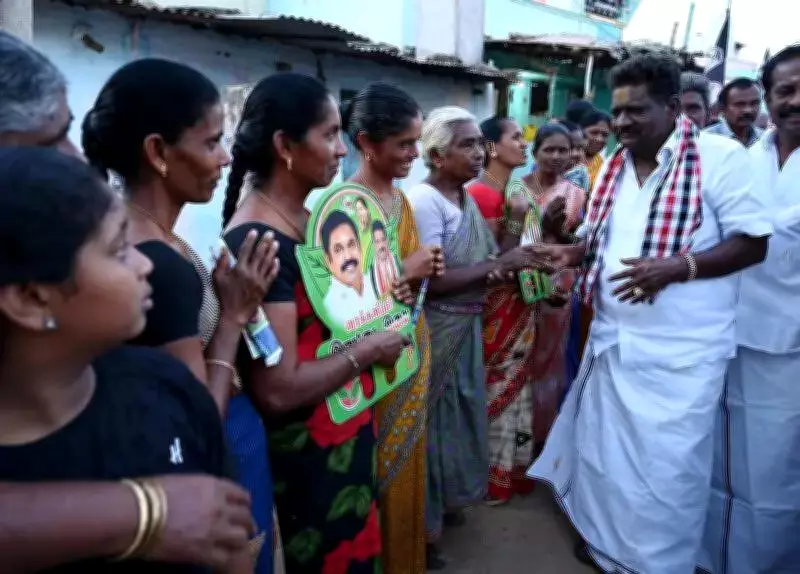
"We will vote for AIADMK this time," declares Palanichamy, adjusting the party's distinctive red-white-black shawl around his neck. The village square is adorned with vibrant flowers and AIADMK flags, creating a festive atmosphere. As darkness falls, the iconic M.G. Ramachandran (MGR) song "Vettriyai Naalai Sarithiram Sollum..." echoes through loudspeakers, heralding the arrival of AIADMK candidate A Logirajan and his convoy.
Nestled against the scenic Western Ghats, the Andipatti constituency, established in 1962, has long been an AIADMK bastion. Historically, both M.G. Ramachandran and J. Jayalalithaa secured victories here in 1984, 2002, and 2006. The region's agrarian economy and significant community of weavers shape its socio-political landscape.

Ramalingapuram village presents an interesting caste demography. While the constituency is dominated by Thevars, a substantial population of Gounders, loyal to AIADMK general secretary Edappadi K. Palaniswami, resides here, as well as in Pitchampatti and Kanniappapillaipatti hamlets.
R Vijayaraj, a 45-year-old farmer from the Gounder community, attentively observes Logirajan's campaign. "At least 1,000 Gounder families live in these three villages. Their support is definitely for AIADMK," he asserts, highlighting the party's grassroots strength.
Constituency Challenges and Voter Concerns
Despite political allegiances, several pressing issues plague the constituency. Residents cite a lack of good roads, inadequate drinking water facilities, and logistical problems such as school buses refusing to pick up children from remote hamlets.
M Mallamma, a 70-year-old villager, watches Logirajan campaign while MGR film songs play in the background. She voices the community's frustrations, emphasizing the need for improved infrastructure and basic amenities.
DMK's Counter-Campaign and Symbolic Gestures
Meanwhile, in S Ranganathapuram village, cadres from the DMK, DMDK, and MDMK gather near a local shrine. DMK candidate A Maharajan arrives, offers prayers at the temple, and enters his campaign vehicle. Supporters greet him with a long string of fireworks and place a headgear made of jasmine and roses on his head—a symbolic gesture anticipating victory.
Maharajan outlines the welfare schemes implemented by the M.K. Stalin-led government and urges villagers to applaud these initiatives. His campaign focuses on leveraging state-level achievements to sway voters.
Historical Context and the Brotherly Rivalry
For decades since 1977, Andipatti remained firmly in AIADMK's grip, with exceptions in the 1989 and 1996 assembly elections. However, the political landscape shifted during the 2019 by-election and the 2021 poll, when Maharajan defeated his brother, A Logirajan, who represents AIADMK.
This election reignites the brotherly rivalry, with both candidates avoiding direct confrontation. Instead, they rely on their respective campaigns, party machinery, and grassroots mobilization to convey their messages. The contest underscores the deep-rooted political divisions and familial dynamics shaping Tamil Nadu's electoral politics.
As the campaign intensifies, voters in Andipatti weigh historical loyalties against contemporary issues, setting the stage for a closely watched battle that could influence broader regional trends.