

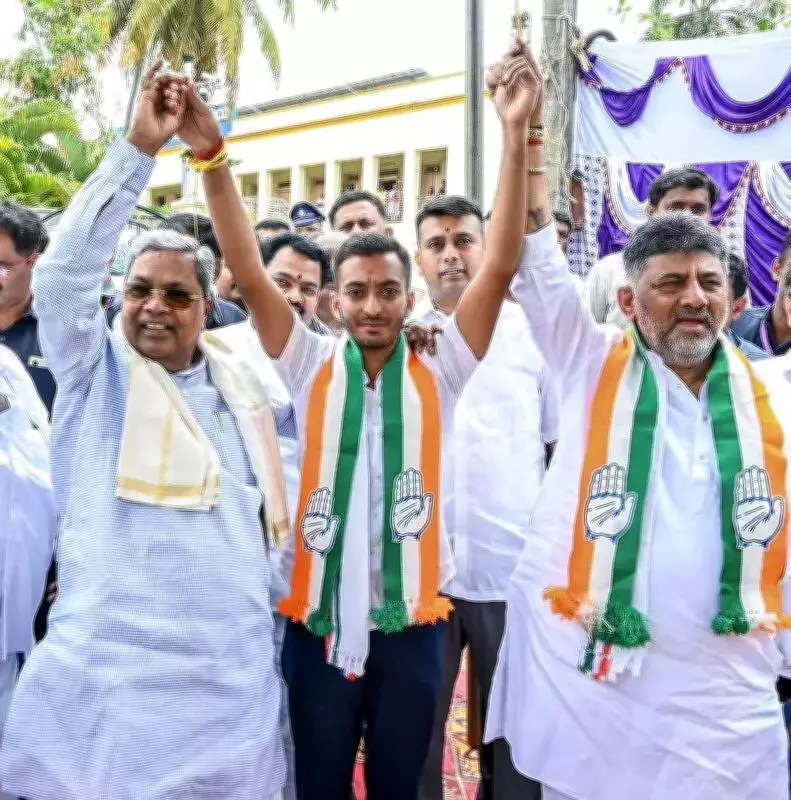
Congress Navigates Caste and Community Tensions in Davanagere South Byelection
The Congress party in Karnataka is embroiled in a complex political balancing act following its candidate selection for the upcoming Davanagere South assembly byelection. The decision to field Samarth Shamanur, a member of the influential Lingayat community, has triggered significant discontent among a section of the Muslim population, which forms a crucial part of the party's traditional support base.
Byelection Context and Community Expectations
The April 9 byelection was necessitated by the death of four-time legislator Shamanur Shivashankarappa, who had represented the constituency for decades. Muslim representatives had actively sought the party ticket, citing their substantial numerical strength—approximately 88,000 voters out of a total electorate of 2.3 lakh. The community had consistently backed Shivashankarappa during his tenure and expected political representation following his passing.
However, the Congress high command ultimately opted for Samarth Shamanur, the grandson of the late legislator. This decision was influenced by local sentiment and the significant political clout of the Lingayat community in the region. HB Manjappa, president of the Congress' Davanagere district unit, explained the rationale, stating, "Usually in a byelection, the party ticket is given to a family member, and the high command followed the same principle in Davanagere South. Moreover, the BJP would have taken advantage if we had picked a Muslim over a Lingayat."

Lingayat Backing and Strategic Calculations
Senior Lingayat leaders within the Congress, including ministers MB Patil and Eshwar Khandre, strongly backed the Shamanur family. They argued that overlooking Lingayat sentiment could prove detrimental to the party in the long run, potentially allowing the BJP to consolidate support among this politically dominant community ahead of the critical 2028 assembly elections. The party brass endorsed this strategic view.
DK Shivakumar, Deputy Chief Minister and Congress state president, acknowledged the minority community's concerns while defending the decision: "There is nothing wrong with the minority community's demand, but we had to consider other critical factors. Shivashankarappa's contribution to the party and Davanagere is unmatched and people remember it with reverence."
Muslim Discontent and Internal Rifts
Despite these explanations, the Muslim community has expressed deep-seated frustration. Housing Minister BZ Zameer Ahmed Khan, who had supported calls for a minority candidate, reportedly offered to resign in protest. AICC general secretary Randeep Surjewala is learned to have told Khan he could proceed if he wished, but Chief Minister Siddaramaiah intervened to defuse the volatile situation.
The developments have exposed internal fault lines within the party. Local Muslim figure Sadiq Pailwan has entered the fray as a rebel candidate, while senior MLC K Abdul Jabbar, who was among the aspirants for the ticket, voiced his dissatisfaction. Jabbar remarked, "The party has made a call, and now it is up to the voters."
Damage Control and Future Assurances
In response to the growing unrest, the Congress has initiated extensive damage control measures. The party is planning a legislative party meeting to bring all sections on board and ensure a united front ahead of the byelection. Senior Muslim members have been tasked with outreach efforts to placate the community, with assurances of future political representation.
These assurances include promises of consideration in the 2028 assembly polls and the upcoming MLC elections. Saleem Ahmed, Congress chief whip, emphasized the immediate priority: "At present, our focus should be to win the election while looking at opportunities ahead."
The situation in Davanagere South underscores the intricate caste and community dynamics that define Karnataka's political landscape, with the Congress walking a tightrope between honoring legacy, managing coalition pressures, and retaining its diverse voter base.






