

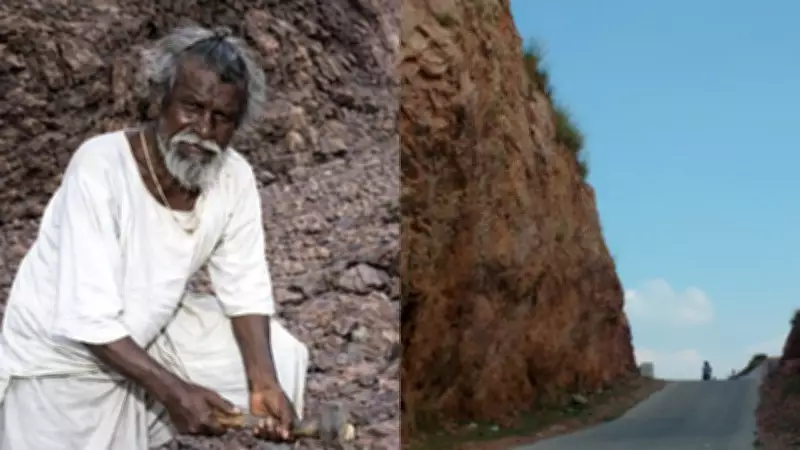
Dashrath Manjhi: The Mountain Man Who Carved a Road Through Love and Grief
In a remote village nestled among the rocky hills of Bihar, a man named Dashrath Manjhi defied all odds to prove that human determination can conquer even the most formidable geographical barriers. Born in 1934 in Gehlaur village near Gaya, Manjhi was a daily wage laborer with no formal education, resources, or institutional backing. Yet, through sheer perseverance, he achieved the extraordinary feat of carving a road through a mountain entirely by hand, driven by love and a profound sense of loss.
A Village Isolated by Nature
Gehlaur village was trapped behind a massive rocky ridge, cutting off residents from essential services like medical care, markets, and employment opportunities. Villagers were forced to travel arduous detours of up to 55–70 kilometers for basic necessities, with life defined by hardship and limited infrastructure. Most worked as agricultural laborers, surviving on uncertain incomes, until a personal tragedy reshaped Manjhi's purpose.
The Tragedy That Sparked a Mission
In 1959, Manjhi's wife, Falguni Devi, suffered a serious injury while navigating the treacherous terrain near the hill. Without a proper road to connect the village to medical facilities, help arrived too late, and she died without timely treatment. Devastated by grief, Manjhi arrived at a radical realization: if a road existed through the mountain, she might have survived. This idea became his life's mission, transforming personal sorrow into a relentless drive for change.

An Impossible Dream Takes Shape
Around 1960, armed with only a hammer and chisel, Dashrath Manjhi began chipping away at the mountain. With no machines, engineers, or funding, his efforts were met with ridicule and disbelief from villagers who thought he had lost his sanity. Undeterred, he worked tirelessly from sunrise to sunset, sustaining himself through labor jobs and even selling his goats to afford better tools. The work was physically exhausting and painfully slow, with each strike removing only a small piece of stone, but his determination never wavered.
22 Years of Unyielding Persistence
For 22 years, from 1960 to 1982, Manjhi continued his solitary endeavor. Gradually, the impossible took form as he carved a road approximately 110 meters long, 9 meters wide, and up to 7-8 meters deep in places. This transformation dramatically reduced the distance between the Atri and Wazirganj areas of Gaya district, turning a long, dangerous detour into a direct and accessible path.
Transforming a Community's Destiny
The new road brought life-changing benefits to the region, providing villagers with access to hospitals during emergencies, schools for children, and markets for livelihood. What began as one man's response to personal grief evolved into a lifeline for an entire community, symbolizing a shift from isolation to opportunity.
Late Recognition and Lasting Legacy
For decades, Manjhi's achievement remained largely unnoticed beyond his village, as he lived simply without seeking fame. Eventually, journalists and local officials brought attention to his work, earning him the title of the "Mountain Man" and inspiring people nationwide. The Bihar government honored his contribution, and upon his death on August 17, 2007, at AIIMS Delhi from gall bladder cancer, he was given a state funeral at age 73—a fitting tribute to a once-dismissed dreamer.
A Legacy Carved from Love and Purpose
What makes Dashrath Manjhi's story profoundly moving is not just the physical feat, but the deep emotion behind it. Motivated by heartbreak and a conviction to prevent others from suffering, he demonstrated that change can begin with a single individual's persistence. In a world often waiting for systemic solutions, Manjhi chose action, proving that determination guided by purpose can reshape even the most immovable obstacles.
Today, the road in Gehlaur, Bihar, stands as more than a passage through rock; it is a testament to human will, patience, and love. Mountains may symbolize permanence, but Dashrath Manjhi showed they can yield to relentless effort, leaving a legacy that continues to inspire generations.






