

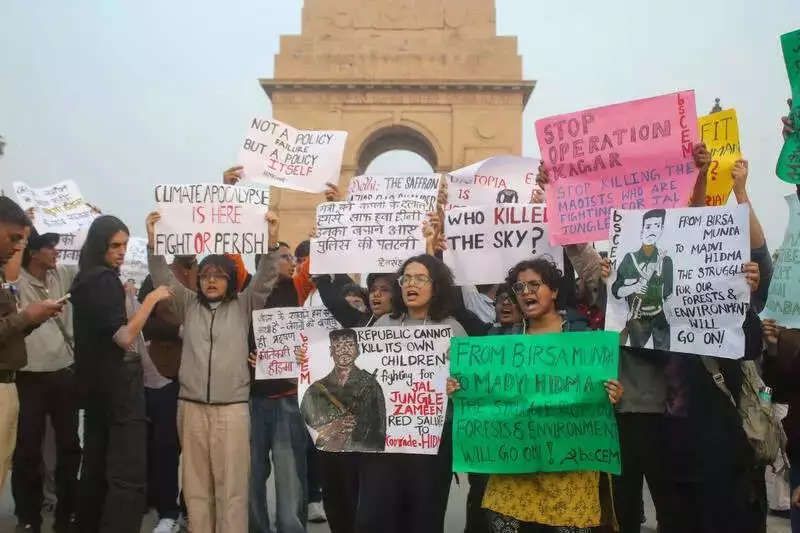
Delhi Air Quality Protest Takes Controversial Turn
What began as a demonstration against Delhi's worsening air quality took an unexpected political turn on Monday when student protesters at India Gate raised chants supporting slain Maoist commander Madvi Hidma. The incident has sparked widespread outrage across political circles and social media platforms.
The protest, organized to voice concerns about the toxic air engulfing the national capital, dramatically shifted focus as young participants began waving posters and placards glorifying the feared Maoist leader. Chants of "comrade Hidma amar rahe" (long live comrade Hidma) echoed through the protest venue, drawing immediate condemnation.
Chhattisgarh Deputy CM's Strong Reaction
Chhattisgarh Deputy Chief Minister Vijay Sharma, who also serves as the state's home minister, responded with sharp criticism to the lionizing of the Maoist leader. Hidma is accused of leading 26 deadly ambushes against security forces during his active years in the Maoist movement.

"They have no idea what Bastar has suffered," Sharma told reporters, accusing the protesters of romanticizing a militant responsible for decades of violence and killings from the comfort of Delhi. The deputy CM issued a direct challenge to the students, daring them to "come to Bastar and see the truth" instead of "sitting in Delhi and giving a call to violence."
In an unprecedented move, Sharma offered to personally arrange the students' travel to Bastar, stating that such a visit would give them "a better understanding of the situation here." He emphasized that "an idea which espouses governance through violence and the use of guns is not sustainable at all."
Political Fallout and Broader Implications
The controversial sloganeering during what was supposed to be an environmental protest has drawn reactions from multiple political quarters. BJP leaders in Delhi quickly shared viral clips of the incident on social media platform X, alleging that the protesters had used pollution concerns as a façade to push a different agenda.
"Posters on pollution, slogans for Naxalites… their real motive is clear," read a post from the party's Delhi unit, suggesting the environmental protest was merely a cover for pro-Maoist activities.
Sharma further elaborated on his position by drawing historical parallels, advising the students to study the Tiananmen Square incident in China, where a Communist government suppressed student protesters. He contrasted this with India's democratic framework, asserting that "Naxalism and whatever it represents cannot be allowed to go on here."
The deputy minister also questioned the protesters' understanding of ground realities in conflict-affected regions, promising to introduce them to a 25-year-old Bastar resident who saw a television set for the first time only recently. This example, he suggested, highlighted the developmental challenges in the region that romanticizing violence does nothing to address.
The incident has opened up broader discussions about the appropriate platforms for political expression and the complex relationship between urban activism and rural realities in India's ongoing development narrative.






