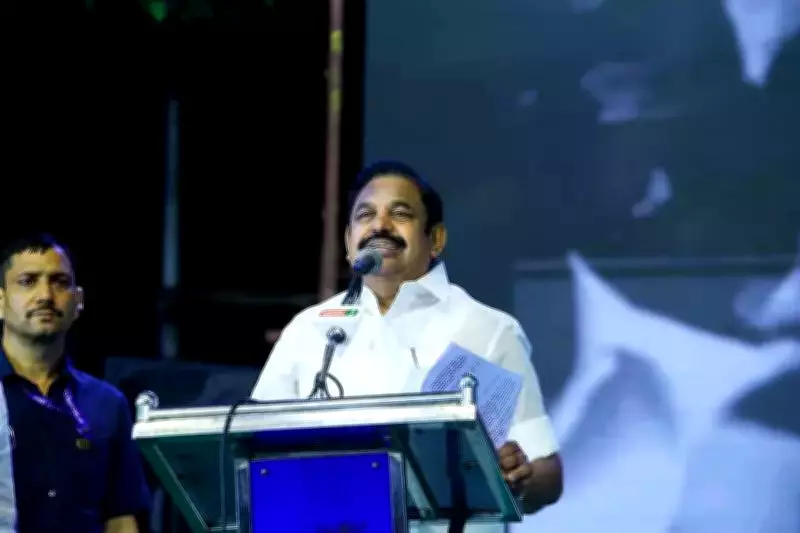
In a fiery address at a public meeting in Virugambakkam, Chennai, AIADMK general secretary Edappadi K Palaniswami launched a scathing attack on Chief Minister M K Stalin and the ruling DMK, daring him to declare that anyone can rise to become party president or chief minister based on merit alone. The event was organized to commemorate the 109th birth anniversary of AIADMK founder M G Ramachandran, drawing a significant crowd of supporters and party workers.
EPS Questions DMK's Dynastic Structure
Responding to Stalin's recent dismissal of opposition criticism as "recycling the old charge" of dynastic politics, Palaniswami pointedly highlighted that key posts in both the DMK party and the Tamil Nadu government are occupied exclusively by members of Stalin's family. "Will Stalin dare say that anyone in his party who works hard can become the leader or chief minister?" EPS challenged, emphasizing his own humble background as a contrast. He noted that he rose from modest beginnings to become the AIADMK's general secretary and the state's chief minister, a journey he claims is impossible in the DMK's current hierarchy.
Targeting Senior Leaders and Alliance Cracks
Taking a dig at the DMK's internal dynamics, EPS questioned why veteran leader Duraimurugan, a long-time legislator, has never been considered for the deputy chief minister's post, suggesting this reflects entrenched nepotism. He made similar charges at an earlier event hosted by a media house in Chennai, reinforcing his critique of the party's leadership structure.

EPS also countered DMK allegations that the AIADMK is a "slave" to the BJP by referencing DMK MP Kanimozhi's recent meeting with Congress leader Rahul Gandhi in Delhi. "Has the DMK shifted its headquarters to Delhi?" he asked mockingly, pointing to visible "squabbles" between DMK and Congress leaders as evidence of cracks in their alliance. He expressed doubts about the coalition's stability leading up to the elections, hinting at potential disintegration.
Confident Predictions and Welfare Promises
Expressing unwavering confidence, EPS predicted that the DMK's "entrenched dynastic politics" would end within two months, with people and government employees eagerly awaiting the elections to deliver a "fitting reply" for what he called hollow poll promises. He forecasted that the AIADMK would return to power with over 210 seats, a majority that would enable significant changes.
In a bold move, EPS challenged Stalin to a public debate to compare the development schemes of the DMK and previous AIADMK regimes, urging, "Let the people be the judge." He alleged that several current ministers are involved in serious corruption and warned they would face consequences once the AIADMK regains power.
Announcing Future Welfare Initiatives
Recalling the party's initial poll promises, such as the Rs 2,000 monthly assistance to all ration cardholders, EPS announced new welfare measures if voted back. These include waiving loans taken by differently abled persons from cooperative banks and an extensive list of schemes for auto drivers, to be detailed in the upcoming manifesto. This focus on grassroots benefits aims to resonate with voters seeking tangible improvements in their daily lives.
The speech underscored a strategic blend of criticism, confidence, and promises, positioning the AIADMK as a merit-based alternative to the DMK's perceived dynastic rule. As political tensions escalate in Tamil Nadu, such exchanges are likely to shape the narrative in the lead-up to the elections.