Surrendered Maoist Leader Reveals 28-Year Underground Life: Surveillance, Firefights & Ideological Stagnation
In a rare and revealing account, surrendered CPI (Maoist) leader Kankanala Raji Reddy, also known as Venkatesh, has emerged from nearly three decades of underground life with a stark narrative of existence within the movement. Based in Hyderabad, Raji Reddy, a former state committee member in Telangana, spent 28 years as an underground cadre, surviving multiple encounters and navigating a world shaped by constant surveillance, repeated firefights, and what he describes as profound ideological stagnation.
Life Under Severe Restrictions and Survival Challenges
Raji Reddy detailed a life of severe restrictions, moving across forests with limited access to basic necessities. He claimed that after Operation Kagar, cadres had no access to medicines or routine medical check-ups, exacerbating their hardships. His daily routine involved waking at 5 am, maintaining constant alertness, and moving primarily at night to avoid detection. For safety, he lived in Karreguttalu, Chhattisgarh, while working for Telangana, before shifting back to the state a few months prior to his surrender on January 4, alongside PLGA battalion commander Badse Sukka alias Deva.
Ideological Stagnation and Failed Responses to Change
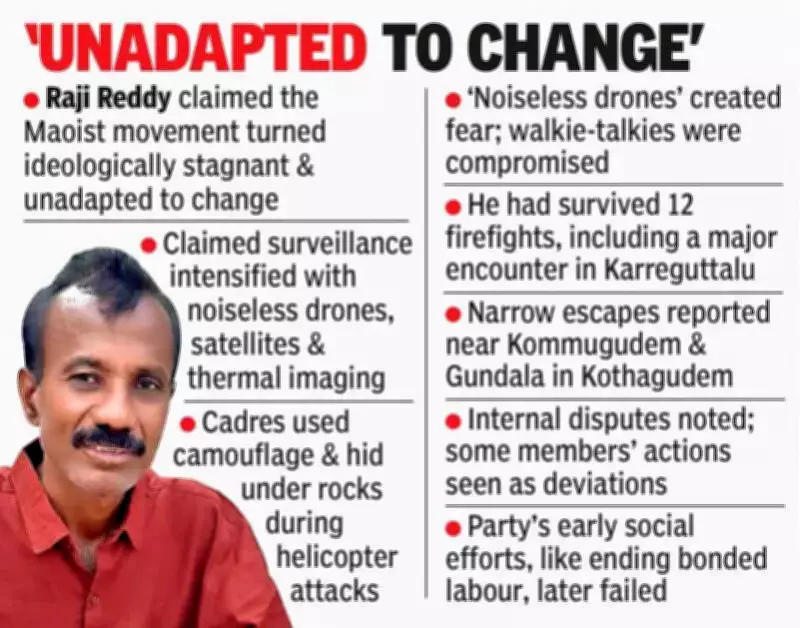
Reflecting on the movement's trajectory, Raji Reddy told TOI that it became stagnant as geographic, political, social, cultural, and technological changes reshaped India. He expressed frustration that the party failed to develop new strategies to address these shifts, leading to a sense of disillusionment. He also highlighted issues like land rights, RoFR pattas, and ST entitlements, alleging that benefits did not reach Adivasis and calling for an end to attacks by forest officials.

Rampant Tree Felling and Loss of Control
As someone in charge of Bhupalpally, Mahabubabad, Warangal, and Peddapalli districts, Raji Reddy spoke about rampant forest cutting in the post-Salwa Judum phase. He claimed that despite warnings, people continued to fell trees, with migrants displaced from Chhattisgarh particularly involved in some Telangana pockets. He cited instances where a single family cleared 10 acres, noting, When the forests in Telangana were under our control, we never allowed irrational felling. But after we lost control, it led to more chopping.
Intensified Surveillance and Counter-Insurgency Operations
Describing counter-insurgency efforts, Raji Reddy detailed regular firing, helicopter attacks, camping, and shelling. He claimed CRPF camps fired at ranges extending 5-6 km, including at night, and asserted there were no civilians in that zone. Surveillance intensified with drones, satellites, and thermal imaging systems that detected heat signals, forcing cadres to wear camouflage and take shelter under rocks during helicopter firing. He referred to noiseless drones that created fear within the group and compromised communication tools like walkie-talkies.
Narrow Escapes and Internal Disputes
On survival, Raji Reddy said he escaped 12 times during exchanges of fire, including a major encounter in Karreguttalu where three people died. He also had narrow escapes near Kommugudem and Gundala in Kothagudem, where bullets missed him. He spoke of internal organisational disputes, referring to members Sonu and Ashanna, whose actions were viewed as a deviation that should have been discussed. Reflecting on earlier years, he noted the party once intervened in social issues like ending bonded labour but later couldn't achieve anything significant.
Personal Betrayal and Motivations
Raji Reddy revealed personal aspects, including his first marriage to an Adivasi woman, Anasurya. He alleged a police ambush at her house resulted in injuries and a commander's death, claiming she informed the police and betrayed the movement. He joined the Maoists to fight landlords, or doras, and owned five acres of land managed by his brothers. Despite the challenges, cadres found moments of respite, watching films with social messages stored on pen drives, such as Virata Parvam.

Adaptations and Final Surrender
To cope with threats, dalams carried anti-venom for snake bites, and cadres adjusted their strategies, such as increasing distance from CRPF camps from 3 km to 5-6 km due to the use of 81 mm weapons. After leaving Karreguttalu, Raji Reddy returned to Telangana and moved with a dalam before ultimately surrendering, marking the end of a long and tumultuous chapter in the Maoist insurgency.