

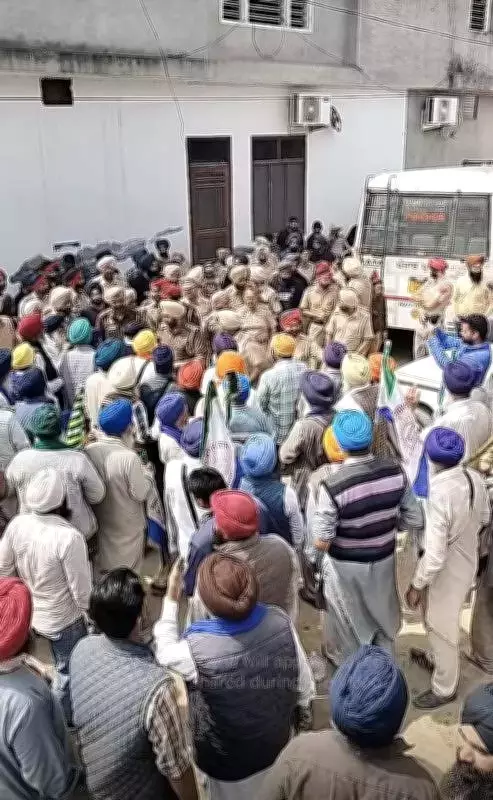
Farmers' Protest Escalates into Tense Standoff with Police in Punjab's Moga District
In a dramatic confrontation that underscores growing agrarian unrest, activists from the Kisan Mazdoor Morcha (KMM) clashed with Moga district police on Friday. The incident occurred as the farmers attempted to march towards Dharamkot, where Punjab Chief Minister Bhagwant Mann was inaugurating key development projects, including a prestigious School of Eminence.
Police Blockade at Lohgarh Gurdwara Sparks Outrage
The farmers, led by Satnam Singh Pannu, president of the Kisan Mazdoor Sangharsh Committee—a core constituent of the KMM—had gathered at the Lohgarh gurdwara near Dharamkot with the intention of proceeding to the CM's event. Their primary goal was to demand pending compensation of Rs 3.7 crore for losses incurred during the demolition of morchas at Shambhu and Khanauri, alongside other pressing agriculture-related issues.
However, a substantial police force swiftly arrived at the location and imposed a strict blockade, preventing the activists from leaving the gurdwara premises. Even a moderated request to conduct a protest march within the village boundaries was firmly rejected by the authorities. This denial prompted the farmers to stage a vocal protest against what they perceive as the state government's suppression of their democratic rights.

Leaders Decry Erosion of Protest Rights and Threaten Political Repercussions
Satnam Singh Pannu expressed deep frustration over the police action, stating, "The state government is snatching our right to speech and protest. We only wanted to hold a peaceful march and pose questions to the CM, but we were not even allowed to step out of the gurdwara." He further warned of political consequences, asserting, "We will not let AAP leaders enter villages during elections," highlighting the potential impact on the ruling Aam Aadmi Party's electoral prospects in rural areas.
Pannu also drew parallels between this incident and a similar event at Jeond village in Bathinda, where farmers were previously barred from protesting within village limits. This pattern, he argued, reflects a systematic effort by the state administration to curb dissent and avoid accountability on critical farmer issues.
Broader Context of Agricultural Demands and Government Response
The protest is rooted in longstanding grievances over unpaid compensation and unaddressed agricultural demands. The Rs 3.7 crore claim relates to financial losses from the demolition of protest sites, a move that has exacerbated tensions between farming communities and the Punjab government. Farmers are calling for urgent action on these matters, emphasizing that delays in compensation and policy implementation are worsening their economic hardships.
As development projects like the School of Eminence are launched, the contrast between government initiatives and grassroots discontent becomes starkly evident. The police's preventive measures, while aimed at maintaining order, have sparked accusations of authoritarian overreach and neglect of farmer welfare.
This standoff in Moga district highlights the volatile intersection of protest rights, agricultural policy, and political accountability in Punjab. With farmers vowing to intensify their agitation, the incident sets the stage for further confrontations unless their demands for compensation and dialogue are met promptly.






