

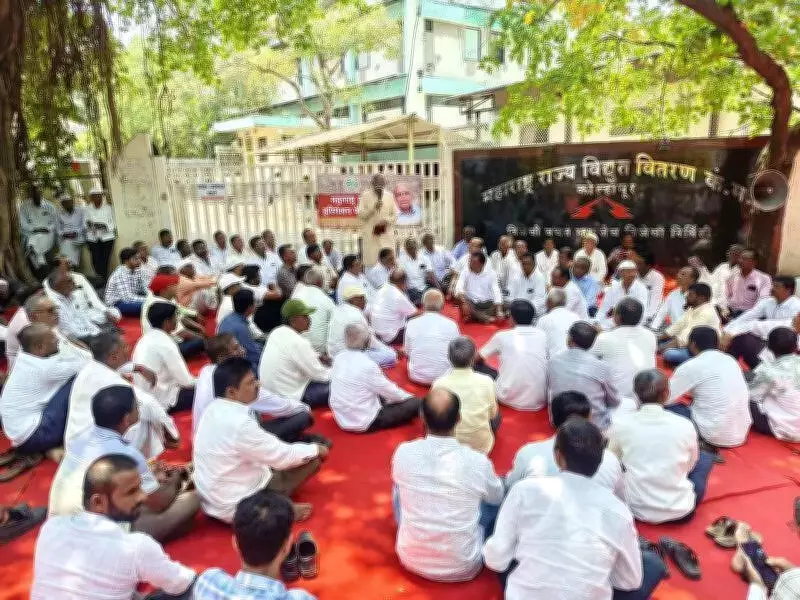
Kolhapur Farmers Stage Protest Over Electricity Supply Issues Affecting Irrigation
Farmers from Kolhapur and Sangli districts gathered outside the Maharashtra State Electricity Distribution Company Limited (MSEDCL) office at Tarabai Park in Kolhapur on Monday to protest against persistent low voltage and erratic electricity supply to agricultural pumps. This disruption has led to uneven water distribution during the critical peak summer season, threatening crop yields.
Coalition of Farmers and Organizations Amplifies Demands
The protest saw participation from representatives of the Maharashtra State Irrigation Federation and various cooperative water supply societies. They highlighted that despite the installation of smart meters, low voltage power supply continues to plague the region, exacerbating irrigation challenges.
Former MLA Sampatbapu Patil emphasized the severity of the situation, noting temperatures soaring beyond 41°C. "Inadequate power supply makes it impossible for farmers to irrigate their crops effectively," he stated. He detailed how frequent power outages and low-voltage conditions are damaging motor pumps of cooperative water supply organizations, many of which are 40 to 50 years old. "Repeated shutdowns and restarts increase pressure on pipelines, leading to higher leakage rates. If unresolved, this could result in crop losses amounting to crores of rupees," Patil warned.

Specific Demands and Opposition to Solar Panel Mandate
Vikrant Patil-Kinikar, Kolhapur district president of the Maharashtra State Irrigation Federation, accused MSEDCL of failing to supply adequate voltage power to both cooperative and individual agricultural pump owners. He outlined key demands:
- Uninterrupted power supply to agricultural pumps for eight hours daily.
- Compensation of equivalent hours if supply is disrupted.
- Provision of electricity at proper voltage for all pumps and cooperative institutions.
Patil-Kinikar also opposed the compulsory installation of solar panels along riverbanks, insisting that such pumps be connected through regular feeders. He demanded that MSEDCL compensate farmers for crop losses directly attributable to power supply failures.
MSEDCL Response and Assurance of Measures
A delegation submitted a written memorandum detailing these demands to MSEDCL chief engineer Swapnil Katkar, warning of intensified agitation if issues remain unaddressed. In response, Katkar acknowledged the prevailing power shortage and assured efforts to minimize disruptions.
"In case of power shutdowns, supply will be restored with higher capacity after 10 PM on the same day. If cooperative water supply organizations request, electricity can be provided for four days during the day and three days at night. We will also assess each feeder to ensure electricity is supplied at appropriate voltage," Katkar stated, outlining steps to mitigate the crisis.
The protest underscores growing tensions between agricultural communities and utility providers in Maharashtra, as climate conditions and infrastructure challenges converge to threaten livelihoods during vital growing seasons.






