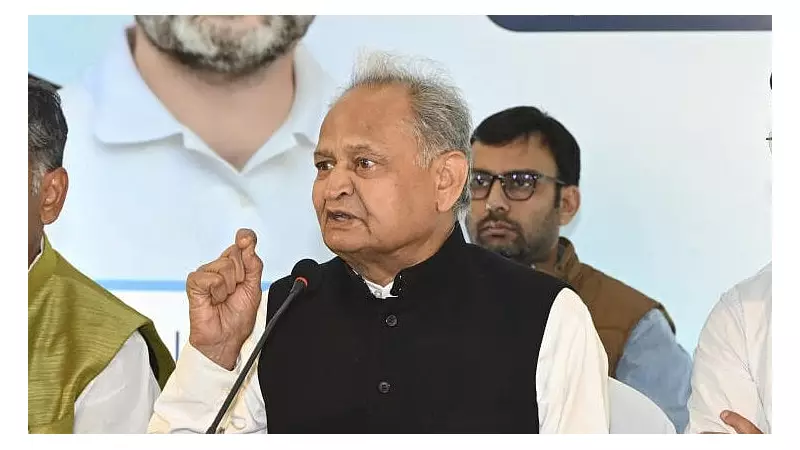
Former Rajasthan Chief Minister Ashok Gehlot has strongly condemned the recent series of attacks targeting the Christian community across India. He stated that such incidents stand in stark contradiction to Prime Minister Narendra Modi's consistent public message of communal harmony and unity.
Gehlot's Visit to a Church and Direct Condemnation
Gehlot's remarks came during a visit to a church in Jaipur on Sunday, February 23. The senior Congress leader used the occasion to express his solidarity with the Christian community and to voice his deep concern over the growing atmosphere of intolerance. He emphasized that the fundamental right to practice and propagate one's religion is enshrined in the Indian Constitution and must be protected at all costs.
"The Prime Minister himself speaks about harmony, but on the ground, attacks on churches and priests are increasing," Gehlot said, highlighting a perceived disconnect between the government's rhetoric and the ground reality. He argued that these violent acts not only harm the targeted community but also tarnish India's long-standing image as a secular and tolerant democracy.

Context of Rising Tensions and Political Responsibility
The former CM's comments are set against a backdrop of multiple reported incidents of violence and harassment against Christians in various states, including allegations of forced conversions and disruptions of prayer meetings. Gehlot placed the onus of maintaining law and order squarely on the ruling dispensation, both at the Centre and in states where such events occur.
He called for immediate and decisive action from the authorities to arrest the perpetrators and ensure the safety of all religious minorities. "It is the responsibility of the government to provide a sense of security to every citizen," he asserted, warning that failure to do so could lead to further social fragmentation.
A Call for Upholding Constitutional Values
In his statement, Ashok Gehlot appealed to all political parties and civil society to rise above partisan interests and collectively defend the secular fabric of the nation. He recalled the principles of Mahatma Gandhi and Jawaharlal Nehru, who envisioned an India where all faiths coexist peacefully.
The Congress leader's visit to the church and his unequivocal condemnation are seen as a significant political statement, aiming to reaffirm his party's commitment to pluralism. The incident has sparked a fresh debate on the state of religious freedom in the country and the challenges in translating messages of peace from the top into reality at the grassroots level.
As the political discourse intensifies, the response from both the central government and the Bharatiya Janata Party to Gehlot's charges is keenly awaited. The coming days will reveal whether this criticism leads to concrete administrative measures to curb such attacks or remains a point of political contention.