

Ghaziabad Mayor Announces Property Tax Hike Rollback Amid Protests
Ghaziabad Mayor Sunita Dayal has declared that the controversial property tax hike, which sparked widespread protests across the city, will be rolled back soon. She stated that senior officials in Lucknow have assured her that the revised rates, which residents claim could increase taxes three to four times in some areas, will not be implemented.
Official Communication and Confusion
A communication issued by the mayor's office on Tuesday confirmed, "A decision not to hike property tax was taken, and people will continue to pay as per the old tax structure." However, the mayor's office did not release any official document confirming that the revised tax structure had been formally withdrawn.
Officials at the Ghaziabad Municipal Corporation (GMC) also reported that they had not received any formal direction to roll back the new rates. A senior civic official, speaking anonymously, said the situation remained unchanged despite the mayor's statement.

"Not a leaf has moved on the matter, and the situation remains the same," the official revealed, adding that municipal commissioner Vikramaditya Singh Malik is scheduled to meet the principal secretary in Lucknow on Thursday to discuss the issue.
Residents Report Sharp Tax Increases
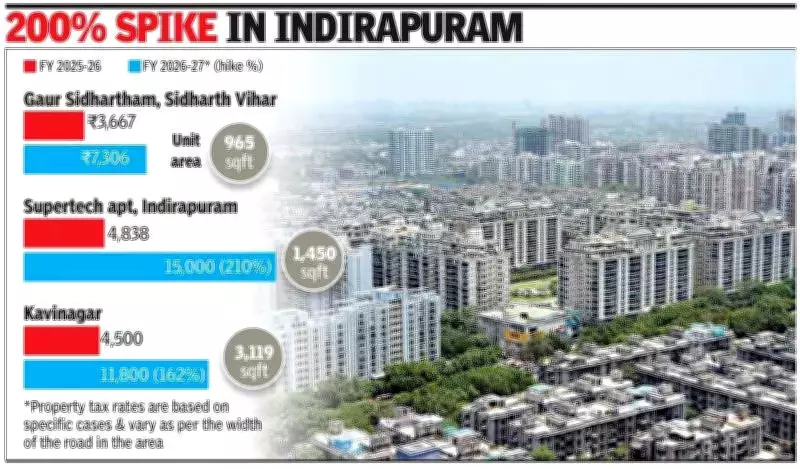
Meanwhile, residents across the city say their property tax demands have already risen sharply under the revised structure. Priti Jha, who owns a 965 square feet apartment in Gaur Siddhartham in Sidharth Vihar, said her property tax has nearly doubled.
In the 2024-25 financial year, her tax was calculated at Rs 3,667, and after a late payment penalty she paid Rs 4,584. "This year the tax for the same flat was calculated at Rs 7,306," she explained, calling the increase "more than 90%."
Residents of Indirapuram report even steeper increases in some societies. Jitendra Kumar, who owns a 1,450 sqft flat in a Supertech apartment in Nyay Khand, said he paid Rs 4,838 in property tax in the previous financial year. "This time I received a tax notice of more than Rs 15,000," he stated.
Commercial Establishments Also Affected
Commercial establishments have also reported a sharp rise in their tax bills. Manoj Singh, who runs a departmental store in Vijay Nagar, said the revision had significantly increased the burden on shop owners.
"Earlier, the maximum property rate for residential units in Vijay Nagar was about Rs 3 per sqft depending on the road width, and for commercial units it was around Rs 15 per sqft," he detailed. "I used to pay about Rs 4,865 as property tax for my shop. After the new tax structure, it crossed Rs 25,000."
Legal Challenges and Municipal Defense
Beyond the increase itself, residents say confusion has persisted since the revised tax framework was introduced from April 2025. In June last year, the GMC board repealed the tax hike proposal after protests, but continued to issue tax notices based on the new structure, deepening uncertainty among property owners.
The controversy also reached the courts after a group of three former councillors challenged the revised tax regime before the Allahabad high court in May last year. In February this year, a bench led by chief justice Arun Bhansali and justice Kshitij Shailendra dismissed the petition.
Following the judgment, the municipal board attempted to soften the impact of the higher rates. On March 7, the civic body announced a set of rebates for residents who:
- Segregate waste at source
- Pay taxes on time
- Live in older buildings
- Make payments through online modes
Civic Officials Justify Revision
Civic officials have defended the revision, saying property tax rates in Ghaziabad were among the lowest in the state before the change. Officials noted that after Lucknow and Kanpur, Ghaziabad and Agra are among the largest municipalities in UP, with 100 wards each.
Despite this, property tax rates in Ghaziabad previously ranged between Rs 1.6 per sqft and Rs 2.4 per sqft in 2024-25, significantly lower than comparable cities. To address this gap, officials said the rates were revised to bring them closer to district circle rates, with the new range set between Rs 1.3 per sqft and Rs 4 per sqft.

They also pointed out that property tax is calculated at 24% of annual rental value (ARV), compared with 31.5% in cities such as Lucknow, Kanpur and Varanasi, and 27.5% in Prayagraj.
Civic officials also compared municipal taxes with maintenance charges collected by resident welfare associations (RWAs) and apartment owner associations (AOAs). "In many housing societies, annual maintenance charges range from about Rs 23.5 to Rs 33.6 per sqft," the official explained. "Even after the revision, the municipal property tax works out to around Rs 3.5 to Rs 4 per sqft annually."
The official argued the revised tax rates remain modest when compared with the scale of civic services provided by the municipal corporation.
Political Reactions and Public Accountability
Former councillor Himanshu Mittal, one of the petitioners who challenged the tax hike in court, however, said municipal authorities should not equate a government body with RWA. "A municipal corporation exists to provide civic services to citizens. It is not an organisation driven by revenue or profit," he asserted.
Political leaders have also weighed in on the controversy. BJP councillor Om Prakash said decisions taken collectively by elected representatives should be respected. "We are accountable to the residents who elected us," he emphasized. "In the larger public interest, property taxes should be reduced."
Opposition leaders have accused the ruling party of failing to resolve the issue. Faisal Husain of the Samajwadi Party said he had written to the chief minister demanding a complete rollback of the revised property tax structure.





