

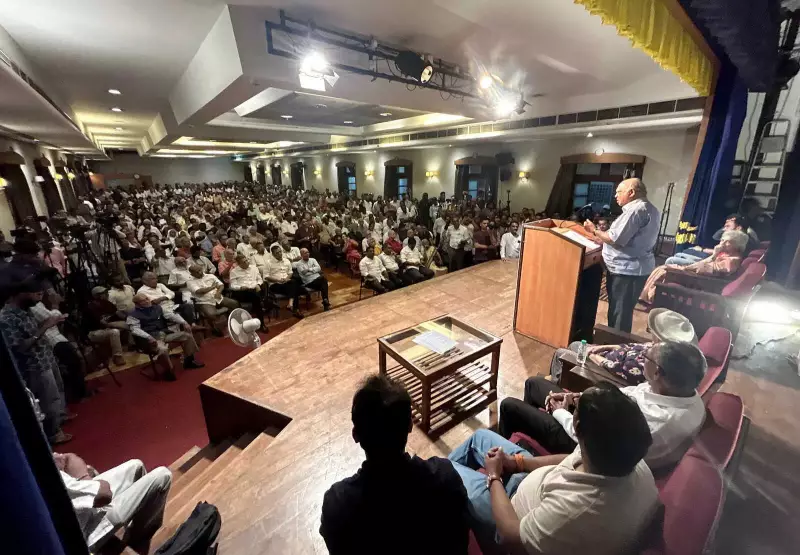
A powerful wave of public dissent swept through Panaji as hundreds of Goans from all walks of life converged for a significant public meeting. The gathering was a direct response to a clarion call for a statewide 'people's movement' by retired Allahabad High Court Chief Justice Ferdino Rebello, who warned of an impending moral and ecological collapse in the state.
A Call to Halt Environmental Destruction
Justice Ferdino Rebello, who also served as a judge at the Bombay High Court, minced no words in his critique of the current development model. He accused the government of treating citizens with contempt and urged it to start listening with empathy. The retired judge vehemently opposed the rampant hill-cutting and forest diversion happening across Goa. "Have Goans ever built on our hills? Hills are not to be developed," he asserted.
He linked unregulated construction and poor planning to the destruction of subsoil and underground water resources. Rebello highlighted the glaring neglect of basic infrastructure like sewerage systems, water supply, and roads. While clarifying that the movement is not anti-development, he demanded a tourism policy that creates dignified jobs for local youth instead of one that destroys villages and Goan identity.

Non-Negotiable Demands and a Non-Partisan Stance
Rebello, a former MLA from Cuncolim, firmly rejected any political ambitions, stating the movement would remain strictly non-partisan. "This is not the movement of any political party. I do not aspire to contest any election," he declared, echoing Chief Minister Pramod Sawant's phrase 'bhivpachi garaz na' (don't be afraid).
He presented a 10-point charter for systemic reform, emphasizing it was "not for any govt, but for Goans." He declared these points non-negotiable. A key demand was the removal of Sections 17(2) and 39(a) of the Town and Country Planning (TCP) Act, arguing that cutting off the money source would curb corruption. "Land that cannot be converted is of no use to them," he remarked. To implement this charter, he called for forming a broad-based organization of activists, NGOs, and non-office bearers from political parties.
Unprecedented Public Mobilization and Broader Support
The scale and diversity of the crowd at the Institute Menezes Braganza were staggering. The audience included:
- Senior citizens and teenagers
- Housewives and working professionals
- Nuns, activists, artists, and retirees
As the main hall overflowed, organizers set up an LED screen at Azad Maidan, where approximately 300 more people gathered to watch the proceedings live.
Rebello urged Goans to engage in peaceful satyagraha, calling it a powerful weapon against oppression. He specifically appealed to women, who constitute half the population, to wake up and claim their right to be heard. He also called upon religious leaders to speak on public morality and Goa's intellectual class to break its silence.
The movement's demands found resonance with other community leaders. Cyril Fernandes, President of the Catholic Association of Goa, demanded special status to prevent outsiders from buying land. Activist Abhijit Prabhudesai called for a complete halt to new hotels, protection of plateaus from mining and industries, and land rights for indigenous communities.






