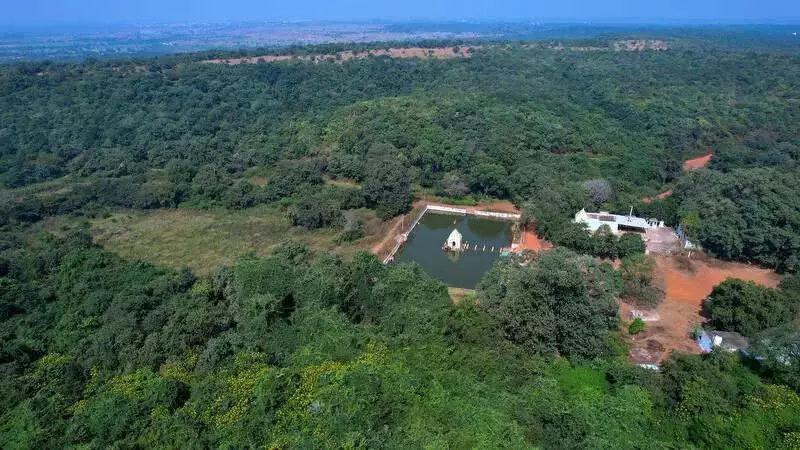
The Telangana High Court has taken a significant step in a case concerning environmental protection and national defence infrastructure. On Monday, the court issued directives to both the Union and state governments concerning the Indian Navy's ambitious Extremely Low Frequency (ELF) radar station project in Damagundam, Vikarabad district.
Court Directs for Detailed Compliance Reports
A division bench comprising Chief Justice Aparesh Kumar Singh and Justice GM Mohiuddin presided over the hearing of a Public Interest Litigation (PIL). The bench has specifically ordered the Union government to submit a compliance report regarding the establishment of the ELF radar project. This report must address the alleged impact of the project on the local biodiversity surrounding the site.
Simultaneously, the state government of Telangana has been directed to provide a separate report. This document must detail the compensatory afforestation measures undertaken to counterbalance the damage caused to forest areas for the project. The court has scheduled the next hearing on this matter for January 2026.

Arguments and Assurances from All Sides
During the proceedings, amicus curiae Vivek Jain informed the court that while over 2,900 acres of land was allotted for the defence project, a primary condition for clearance was minimal disturbance to flora and fauna and minimal tree felling. He emphasized that the project's clearance was contingent on the Navy undertaking compensatory afforestation, with the state obligated to maintain double the extent of the degraded forest land diverted.
Jain clarified that the defence authorities were not seeking a complete exemption from environmental norms. He pointed out that the permission, as confirmed by the Union government in its counter-affidavit, is explicitly subject to the specific conditions laid down by the Union Ministry of Environment, Forest and Climate Change (MoEFCC).
The counsel representing the Union government assured the court that although compensatory afforestation is not legally mandatory for a central government organisation, the Indian Navy has voluntarily agreed to bear the full cost. The afforestation will cover double the degraded forest area, backed by a formal compensation action plan. The counsel gave assurances that no damage would be caused to local flora and fauna, and any tree felling would be strictly limited to unavoidable circumstances and conducted under the forest department's supervision.
State Reveals Hurdle in Local Biodiversity Committee
The counsel for the Telangana state government presented a procedural hurdle to the bench. It was revealed that the Biodiversity Management Committee (BMC) for the concerned area, which operates under the village sarpanch as its ex-officio chairman, has been non-functional since November 2022. This was due to the previous sarpanch demitting office.
The state counsel assured the court that with the ongoing process of electing new sarpanches, the committee would soon resume its vital function in managing and conserving local biodiversity. After recording all these submissions and assurances, the division bench adjourned the case.
The PIL itself seeks to restrain the Telangana government from allotting land in Damagundam to the Eastern Naval Command for this project and demands robust compensatory afforestation for the alleged damage to forest cover. The court's directives mark a crucial phase in balancing strategic defence needs with imperative environmental conservation.