

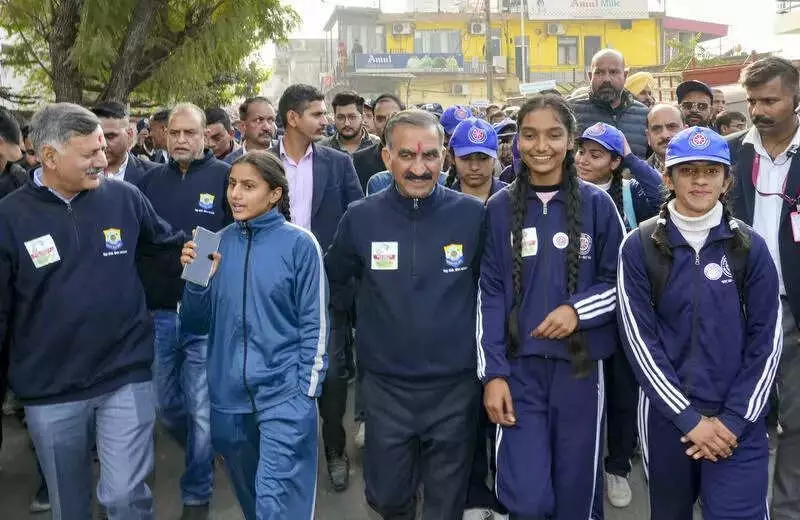
In a powerful display of public resolve, Himachal Pradesh Chief Minister Sukhvinder Singh Sukhu spearheaded a significant anti-drug awareness walkathon in Bilaspur on Friday. This event marks a crucial step in the state's ongoing, aggressive public campaign targeting the menace of 'chitta' and other narcotics.
A Collective Pledge Against Narcotics
The walkathon, which saw massive participation, commenced from the Government Senior Secondary School (Boys) and concluded at the Luhnu Ground. Students, public representatives, government officers, and local residents joined the Chief Minister in the march. At the ground, CM Sukhu administered an oath to the participants, who vowed to work collectively to rid Himachal Pradesh of chitta and other addictive substances.
Addressing the large gathering, the Chief Minister described chitta as a "slow poison" that is devastating the youth, breaking apart families, and imposing a heavy social stigma. He reminded the audience that the state government initiated this mass movement from Shimla's historic Ridge Maidan on November 15, with subsequent campaigns in Dharamshala and Hamirpur. The Bilaspur event stands as another strong milestone in this people's movement.

Government's Multi-Pronged Strategy: Enforcement & Rehabilitation
CM Sukhu emphasized that the government's approach is comprehensive, moving beyond mere slogans. He outlined a dual strategy of stringent enforcement coupled with compassionate rehabilitation. On the enforcement front, he shared key details from recent operations:
- During a state-wide 'Naka' campaign from November 17 to 19, 208 checkpoints were established, nearly 28,000 vehicles were checked, leading to several NDPS cases and 33 arrests.
- On November 22, simultaneous searches at 124 locations resulted in 9 NDPS cases and 9 arrests.
- A special drive around educational institutions on December 25 led to 12 cases and 385 challans.
The government is actively using the Prevention of Illicit Traffic in Narcotic Drugs (PIT-NDPS) Act to detain habitual offenders. Action has been initiated against 66 criminals under PIT and NDPS provisions, including the detention of 19 notorious chitta traffickers on December 6 and 19. Furthermore, action is underway against 72 identified cases of illegal properties funded by drug money, with proceedings completed in 14 cases.
Focus on Youth and Community Participation
The Chief Minister made a fervent appeal to all sections of society, particularly the youth, to actively engage in this battle. He expressed confidence that the youth of Himachal would stand shoulder-to-shoulder with the government to create a drug-free state. To institutionalize this participation, he announced the upcoming launch of an 'Anti-Chitta Volunteer Scheme'.
This scheme will train college and university students, NCC and NSS cadets, youth club members, and socially conscious citizens to become frontline volunteers in the campaign. Community-based strategies are also being strengthened, with meetings already held in 234 drug-affected panchayats to bolster local intelligence and prevention efforts.
Major Investment in Rehabilitation
Highlighting the rehabilitation pillar of the strategy, CM Sukhu made a significant financial announcement. The government has released Rs 20 crore for the development of a de-addiction and rehabilitation centre at Kotla Barog in Sirmaur district. This underscores the administration's commitment to helping victims recover and reintegrate into society.
Additionally, to curb the illegal diversion of pharmaceuticals, inspections of manufacturing units are being conducted. The Chief Minister's comprehensive address in Bilaspur reinforced a clear message: Himachal Pradesh is waging a determined, multi-front war against the drug epidemic, combining the might of the law with the power of community will.

