

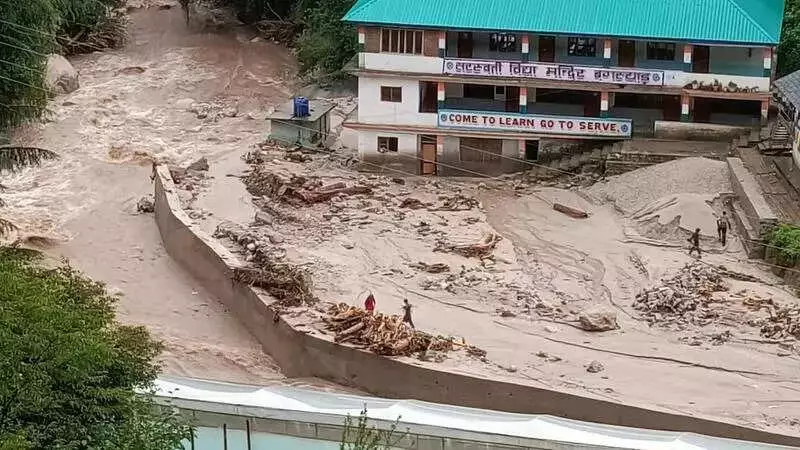
The Himachal Pradesh High Court has expressed strong disapproval of the state government's failure to direct private companies to fulfill their Corporate Social Responsibility (CSR) obligations, especially in the wake of the devastating monsoon disaster that struck the state earlier this year. The court has demanded to know what proactive steps the government plans to take against firms that have not contributed effectively to relief and rebuilding efforts.
Court's Stern Observations on Government Inaction
A division bench comprising Chief Justice Gurmeet Singh Sandhawalia and Justice Jiya Lal Bhardwaj issued the order after reviewing affidavits from both the state and central governments. The bench did not mince words, stating, "We are of the considered opinion that both the Union of India and the state have been remiss in their duties and have not realised the ambit of statutory provisions of Section 135 of the Act and the benefits which have to be rolled out to the general public."
The court has specifically ordered the state to identify all industries in Himachal Pradesh that fall under the provisions of Section 135 of the Companies Act, 2013. This section mandates that companies meeting certain financial thresholds must spend at least 2% of their average net profits from the preceding three years on CSR activities, with preference given to the local areas where they operate.

Shocking Data Reveals Massive Shortfall
According to information presented to the court, the state government identified 80 companies that qualify under Section 135 for the financial year 2025-26. These are firms with a net worth of Rs 500 crore or more, a turnover of Rs 1,000 crore or more, or a net profit of Rs 5 crore or more.
Despite this, the total CSR contribution from these companies for various activities, including disaster relief, was a mere Rs 47.52 crore. The bench pointed out an even more alarming fact: a large number of companies have not even bothered to inform the state about their CSR contributions for the year.
The court highlighted a glaring contradiction in the official records. An affidavit from the deputy director of the Union Ministry of Power claimed that no request for CSR funding was received from the Himachal government to repair infrastructure damaged by the 2025 heavy rainfall. However, the affidavit also noted that three central public sector undertakings—National Thermal Power Corporation (NTPC), National Hydroelectric Power Corporation (NHPC), and Satluj Jal Vidyut Nigam (SJVN)—had made CSR contributions for the work, acknowledging the unprecedented nature of the rainfall.
Path Forward and Accountability
The High Court's intervention underscores a significant gap in governance and the enforcement of laws designed to channel corporate profits towards public welfare, particularly during crises. The court's directive is a clear push for the state machinery to move from a passive to an active role in ensuring compliance.
The aftermath of the 2025 monsoon disaster, which crippled large parts of Himachal's infrastructure, makes this enforcement not just a legal formality but a critical necessity for rehabilitation and resilience building. The court's order is expected to compel the state to create a robust mechanism for tracking, mandating, and utilizing CSR funds as intended by law.






