

Hyderabad Traffic Gridlock: Unregulated Pedestrian Crossings Paralyze Key Secunderabad Corridor
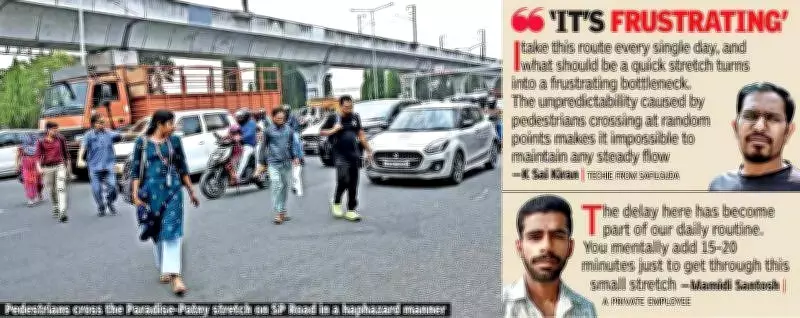
Commuters traveling between Marredpally St John's signal and Begumpet in Hyderabad are experiencing severe and frequent delays along a crucial Secunderabad corridor. The primary culprit disrupting the smooth flow of traffic is unregulated pedestrian crossings between the Patny and Paradise flyovers, creating a daily nightmare for thousands of road users.
Tripled Travel Times and Peak Hour Chaos
A stretch that typically takes about five minutes to cover now often requires 15–20 minutes, with delays extending even longer during morning and evening rush hours. The congestion is particularly concentrated at the exit ramp of the Patny flyover and the entry ramp of the Paradise flyover, where a constant stream of pedestrians crosses the road throughout the day.
The absence of designated pedestrian infrastructure has created a dangerous situation where motorists and pedestrians compete for the same space, significantly reducing the efficiency of the flyover system. This conflict affects thousands of daily commuters, including office-goers, students, and public transport users who rely on this vital corridor.

Commuters Express Frustration and Exhaustion
Kothapally Sai Kiran, a technology professional from Safilguda who travels daily to Hitech City, described the experience as increasingly difficult. "I take this route every single day, and what should be a quick stretch turns into a frustrating bottleneck. The unpredictability caused by pedestrians crossing at random points makes it impossible to maintain any steady flow. It's truly exhausting, especially after a long workday," he stated.
Mamidi Santosh, a private employee working in Begumpet, highlighted how the delays have become routine. "The delay here has become part of our daily schedule. You mentally add 15–20 minutes just to get through this small stretch. Even when traffic seems clear on the flyover, everything comes to a halt near the ramps because of constant pedestrian movement," he explained.
Pedestrians Cite Lack of Safe Alternatives
Pedestrians using the same stretch pointed to the absence of safe crossing options as the root cause of the problem. One pedestrian near the Paradise flyover revealed, "We don't have a proper place to cross safely. There are bus stops and shops on both sides, so people naturally try to cross wherever possible. It's risky for us, but there's no alternative."
Another pedestrian described peak-hour conditions as particularly chaotic. "During rush hours, it becomes extremely difficult to navigate. Vehicles don't stop fully, and pedestrians hesitate midway. Everyone is trying to move simultaneously, which creates confusion and slows down both traffic and foot movement," the individual noted.
Traffic Police Identify Permanent Solution Needed
Begumpet Traffic CI G Janaki Ramulu confirmed that pedestrian crossings are the primary cause of congestion in this stretch. "To manage the situation, we have deployed constables on both sides to regulate movement and are facilitating pedestrian crossings in groups of approximately 15 at a time," he explained.
"We have been consistently proposing to GHMC the construction of a foot overbridge, which we believe is the only permanent solution to this issue," Ramulu emphasized, highlighting the need for infrastructure improvements.
Underlying Factors and Broader Impact
The presence of commercial establishments, public transport access points, and residential areas along Parklane ensures pedestrian movement remains high throughout the day. Without grade-separated infrastructure like foot overbridges or underpasses, the conflict between foot traffic and vehicular movement continues to degrade travel time and road usage efficiency along this busy corridor.
Traffic movement becomes particularly sluggish during morning and evening rush hours when both vehicular and pedestrian volumes rise simultaneously. The resulting bottlenecks often extend beyond the ramps, affecting adjoining roads and increasing travel time across the entire corridor, creating ripple effects throughout Secunderabad's transportation network.






