

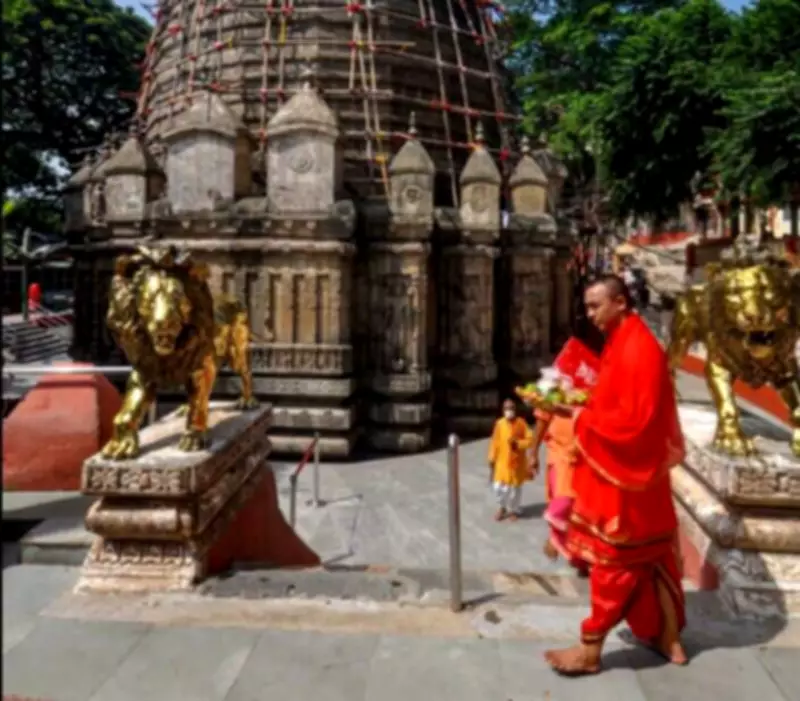
Kamakhya Temple Emerges as Key Political Pilgrimage Destination Ahead of Assam Elections
As campaign fervor intensifies across Assam, a notable trend has emerged with numerous candidates making strategic visits to the revered Kamakhya Temple in Guwahati. These pilgrimages are widely interpreted as calculated efforts to resonate with deep-rooted cultural sentiments during this critical phase of political campaigning.
Elaborate Rituals Performed for Electoral Success
Ministers and MLAs, adorned in traditional attire, are arriving at the temple's sanctum sanctorum to participate in elaborate rituals conducted by priests. While often conducted away from public view, these ceremonies carry unmistakable political significance. According to Jyoti Kumar Sarma, priest and president of Bagala Temple located in the Nilachal Hills, the most sought-after ritual during election season is the "Bagalamukhi Puja."
"The primary purpose of this ritual is to overcome political obstacles and achieve victory in elections," explained Sarma. "Whoever the candidate may be, we take this resolution to help them win the elections."

Temple authorities confirm that politicians perform these rituals to appease the goddess with hopes of electoral triumph. Beyond mere victory, many also seek enhanced influence, greater public attraction, and the suppression of political opponents through these spiritual practices.
Significant Increase in Political Visitors
With the election date approaching rapidly, Sarma revealed that approximately 50-60 politicians from various political parties have already performed pujas at the temple. He emphasized that the Bagalamukhi Puja must be conducted according to prescribed vidhi (procedures) under the guidance of knowledgeable priests due to its tantric aspects.
Some politicians also participate in additional rituals including 'bali' puja, which involves sacrificial elements, and badha puja, specifically designed to remove obstacles from their political paths.
Historical and Contemporary Significance
The Kamakhya Temple, which typically receives between 25,000 to 30,000 devotees daily, has long attracted politicians from both major parties including Congress and BJP. Himadri Sarma, chief priest of Kamakhya Temple, elaborated on this tradition.
"Goddess Kamakhya is considered the eternal goddess, and no significant undertaking should begin without first visiting this holy temple," stated the chief priest. "While devotees visit throughout the year, we observe a substantial increase in visitors during election periods as everyone brings their specific hopes and devotion."
He noted that most political visitors are devotees of the Bagalamukhi Temple, though some also visit temples dedicated to Goddess Tara, Bana Durga, and Lalita Kanta within the complex.
Evolution of Political Temple Visits
According to temple authorities, such political visits have become increasingly common in recent election cycles. In earlier elections, politicians rarely made public appearances at the temple, but the proliferation of social media has transformed these spiritual visits into powerful publicity tools. The visual documentation and sharing of these pilgrimages now serve dual purposes—fulfilling spiritual obligations while simultaneously demonstrating cultural connectivity to potential voters.
The convergence of political ambition and spiritual practice at Kamakhya Temple highlights how traditional religious sites continue to play significant roles in contemporary electoral strategies, particularly in regions where cultural and spiritual identities remain deeply intertwined with political consciousness.






