

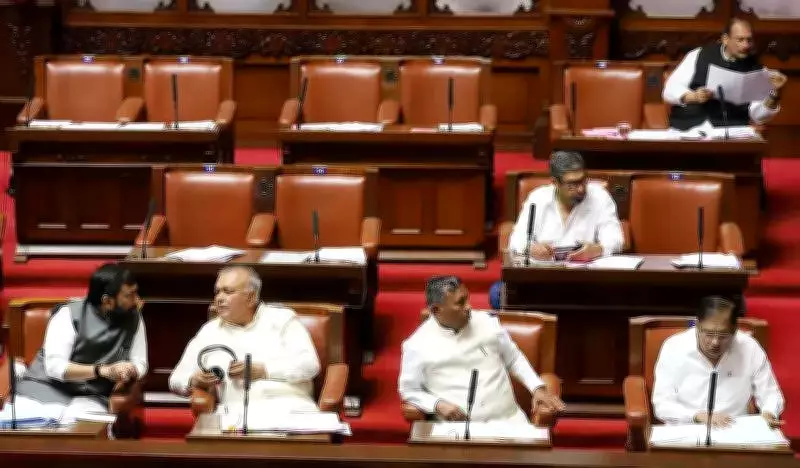
Karnataka Assembly Erupts in Debate Over DJs and Item Songs at Cultural Events
What started as a routine discussion about funding for cultural festivals quickly escalated into a contentious and noisy divide in the Karnataka Legislative Assembly on Wednesday. Legislators found themselves sharply split over the controversial issue of whether disc jockeys (DJs) and 'item songs' have a place at religious jayantis and public processions, with arguments flying from both sides of the aisle.
Ministers Push for Ban, Citing Cultural Concerns
Labour Minister Santosh Lad spearheaded the call for prohibition, stating emphatically, "DJs have become a massive problem at jayantis and festivals across the state." He expressed dismay at the current trend, noting, "It has reached a point where gods do not move forward in a procession without a DJ blaring and an item song playing. This is shameful and does absolutely no good for our rich cultural heritage. They should be banned outright."
Kannada and Culture Minister Shivaraj Tangadagi endorsed this view, appealing for bipartisan cooperation. "The BJP should cooperate with us on this matter," he urged. "We are prepared to issue an official order because DJs are creating numerous problems at these events. If everyone agrees, it will be implemented swiftly."

Opposition Resistance and Counterarguments
However, the Bharatiya Janata Party (BJP) legislators refused to buy into the argument for a blanket ban. SN Channabasappa hit back forcefully, declaring, "They (the Congress) may not want DJs, but we certainly want them. You cannot simply do as you please." In a provocative retort, he challenged, "If you can, ban the azaan (Islamic call to prayer) as per a Supreme Court order first."
At this point, Speaker UT Khader intervened to clarify the legal standing, noting that the Supreme Court order specifically concerns decibel limits and noise regulation, not outright bans on specific sounds.
Interestingly, not all BJP members stood united against restrictions. Senior leader Suresh Kumar voiced support for curbs, stating, "I agree that DJs and item songs are not part of our traditional culture." He added a public health perspective, saying, "I have personally witnessed people with pacemakers suffering and children covering their ears due to the excessive noise. We must seriously consider the issue of noise pollution."
Broader Context: Funding for District Festivals
The heated exchange was actually triggered by a question regarding funding for the Sahyadri or Malnad utsav in Shivamogga district. Earlier in the session, members from both the treasury and opposition benches had pressed the government to allocate dedicated funds for district-level utsavs (festivals). They argued these events are crucial for promoting local culture and providing support to regional artists, with several legislators calling for a clear policy to institutionalize such celebrations.
Raising the issue during question hour, lawmakers emphasized that district utsavs provide an essential platform for regional talent and help preserve traditional art forms that might otherwise fade away. Channabasappa highlighted the increasing demands coming from various districts across Karnataka.
In response, Minister Tangadagi acknowledged the growing pressure, noting, "People from each district are now consistently asking for funds for district-level utsavs." He explained that while guidelines exist, formal proposals must originate from the districts themselves. "If these utsavs are celebrated at historical places like Hampi and Anegundi, it would be beneficial, but it would pose a significant logistical and financial problem for the department if all districts simultaneously launched such large-scale celebrations," he cautioned.

Calls for Structured Policy and Year-Round Planning
Speaker UT Khader urged a more structured governmental approach, advising, "Please allot specific funds for each district and transfer them directly to the deputy commissioners." He stressed the need for a dedicated policy, warning, "Frame a separate policy for this; otherwise, our younger generation and children will forget local culture and tradition amid the overwhelming influence of western trends."
BJP legislator V Sunil Kumar suggested organizing state-level utsavs that rotate across different regions, complementing district events. Meanwhile, fellow BJP member Janardhan Reddy called for the revival of the Anegundi utsav, highlighting specific cultural heritage sites.
Rural Development and Panchayat Raj Minister Priyank Kharge proposed a more sustainable model, stating, "We should create a throughout-the-year event calendar rather than concentrating resources on isolated festivals." He pointed out the financial imbalance, "Approximately Rs 20 crore is spent on some two-day festivals, but what about the remaining 363 days of the year? We need better distribution."
Labour Minister Santosh Lad added a fiscal perspective, noting that costs often escalate dramatically due to high-profile, big-ticket performances at these events, further complicating budget allocations.
The assembly session thus revealed deep divisions not only on the cultural appropriateness of modern entertainment at traditional events but also on the broader challenges of funding, planning, and preserving Karnataka's diverse cultural landscape in a rapidly changing society.





