

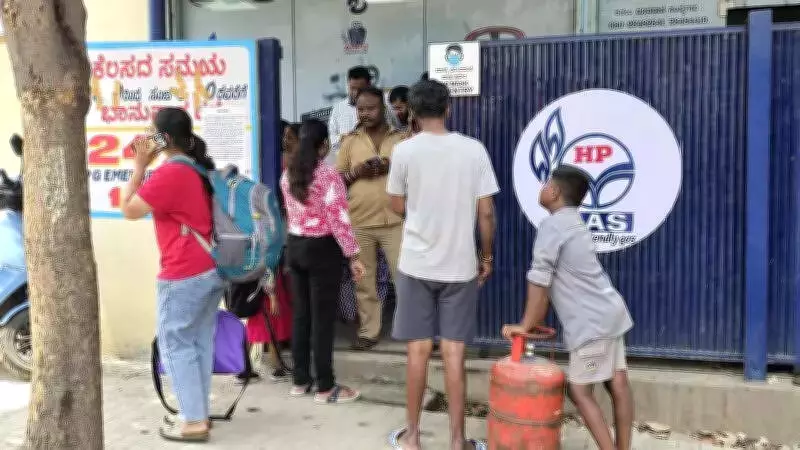
Karnataka Legislative Council Confronts LPG Crisis, Prioritizes Hotels with 10,000 Cylinders Daily
The ongoing LPG crisis in Karnataka took center stage in the Legislative Council on Monday, sparking intense debate among Members of the Legislative Council (MLCs) from various political parties. They urged the state government to prioritize LPG supply for hotels and restaurants, particularly in urban hubs like Bengaluru, where a significant portion of the working population relies on eateries for daily meals.
Government Response and Allocation Details
Minister for Food and Civil Supplies, KH Muniyappa, acknowledged the severity of the situation but appealed to the hospitality sector to "adjust" for another week, expressing optimism that conditions would improve soon. Following discussions with major oil companies, Muniyappa informed the Council that the hospitality sector—encompassing hotels, restaurants, dhabas, canteens, and paying guest facilities—would receive 10,000 commercial LPG cylinders daily.
He explained, "Before the LPG crisis triggered by the Middle East conflict, oil companies were supplying 45,000 commercial LPG cylinders to hotels. Now, the central government has permitted a supply of 16,105 commercial LPG cylinders, out of which 10,000 will be allocated to hotels and restaurants on a priority basis."

Criticism and Alternative Solutions
However, Congress MLC Iwan D'Souza objected to this limited allocation, stating, "This will cater to only 20% of hotels. Should the remaining 80% shut down operations? If not LPG, the state government must at least ensure supply of firewood to these hotels!" In response, Forest Minister Eshwar Khandre clarified, "We have banned the axing of trees for firewood, and any such attempt will be dealt with seriously."
Muniyappa attempted to allay concerns by emphasizing, "We are gradually emerging from a crisis scenario. Ten percent of supply is better than nothing. At least with this, every hotel will get some respite. If hotels were previously using five LPG cylinders, they may now get one. As this is a global crisis, hoteliers and restaurants must adjust for a few days. They can balance demand by using alternatives such as electric or firewood stoves. The situation is expected to improve in the coming days."
Additional Allocations and Long-Term Strategies
Beyond the 10,000 cylinders for the hospitality sector, the government has decided to distribute the remaining 5,000-plus cylinders among essential sectors on a priority basis. These include:
- Pharmaceuticals
- Fisheries
- Sericulture
- Other critical industries
Muniyappa highlighted India's dependency on Middle Eastern nations for 75% of its LPG supply, noting, "If we had diversified into solar and biogas earlier, the current crisis could have been mitigated. The UPA government promoted these alternatives, and the present NDA government is also working in that direction to achieve self-reliance in cooking gas. Until then, global issues will continue to affect us, and we must adjust. The central government is cooperating with us, especially after the chief minister's request for increased LPG allocation to Karnataka."
Regulatory Measures for Transparency
The LPG crisis has prompted the state government to tighten regulations over the sale and distribution of commercial LPG cylinders across Karnataka, a sector that has previously lacked comprehensive oversight. To ensure transparency and curb black-market activities, all commercial LPG users have been directed to mandatorily register with the Gas Authority of India Limited (GAIL) immediately.
Muniyappa stated, "All commercial LPG users must register with GAIL immediately to eliminate black-market control and ensure transparency in distribution. This process must be completed within a week. It will help us assess demand and supply accurately and will also be useful in the future transition to a Piped Natural Gas (PNG) network. Our goal is to prevent misuse and ensure gas reaches genuine users through a record-based distribution system."






