

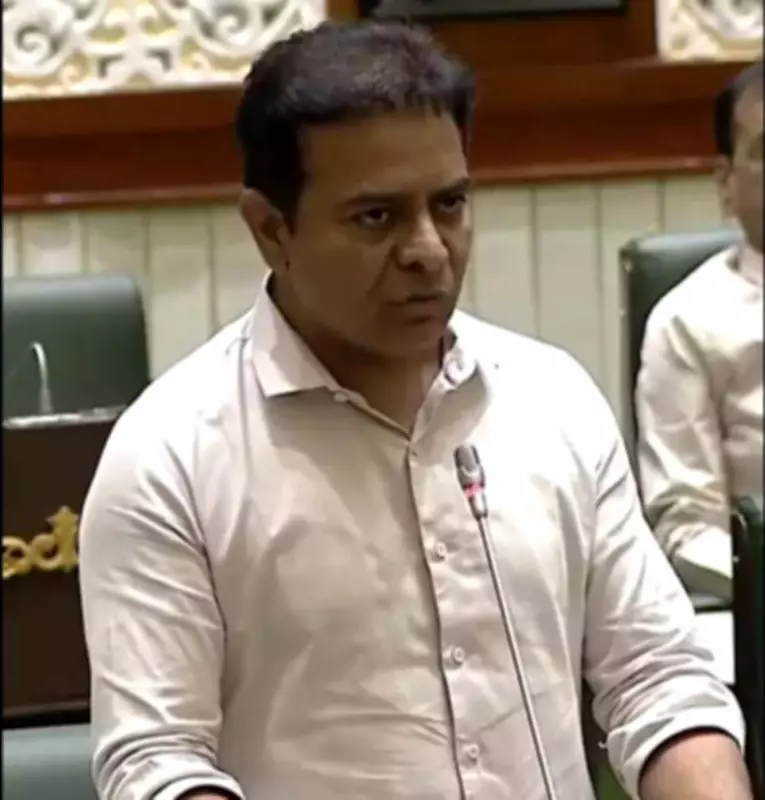
KTR Defends Assembly Speech, Insists He Only Referenced CM's Words
In a recent development in the Telangana Legislative Assembly, BRS working president KT Rama Rao (KTR) has firmly defended his speech, asserting that he did not employ any unparliamentary language. He emphasized that his remarks merely echoed what Chief Minister Revanth Reddy had previously stated, sparking a debate over parliamentary decorum.
Clarification on Defection Petitions and Assembly Discussions
Responding to Chief Minister Revanth Reddy's comments, KTR argued that there was nothing inappropriate in addressing the issue of defection petitions. He highlighted that the assembly has historically engaged in discussions on topics such as party defections, court rulings, and reservations. "The assembly did not remove the chief minister's inappropriate words from the records. How can it be unparliamentary if I merely refer to what he said?" KTR questioned, challenging the objections raised against his statements.
Objections and Defense of Parliamentary Conduct
On Tuesday, KTR faced objections over his assembly speech, to which he responded by stating, "Speaker sir, no one has pointed out anything unparliamentary in what I said yesterday. I do not believe I spoke in an unparliamentary manner. If I had, you would have stopped me right then. Since you are listening to everything, there is no need to remove anything from the records." He stressed that his language was within acceptable bounds and did not include derogatory terms like 'sacrificial deity,' which he attributed to the CM.

Constitutional Limits and Historical Precedents
KTR further elaborated that assembly discussions are conducted within constitutional frameworks, serving as a platform for lawmaking. "The legislative assembly is an institution that operates within constitutional boundaries. There have been instances where discussions on high court and Supreme Court judgments have taken place. Recently, despite court rulings on BC reservations, we discussed them in the assembly," he explained. This underscores his view that referencing past statements, including the CM's, is a legitimate part of parliamentary discourse.
He concluded by opining that if the chief minister's comments remain on official records, his own remarks should also be retained, reinforcing the principle of fairness in assembly proceedings.






