

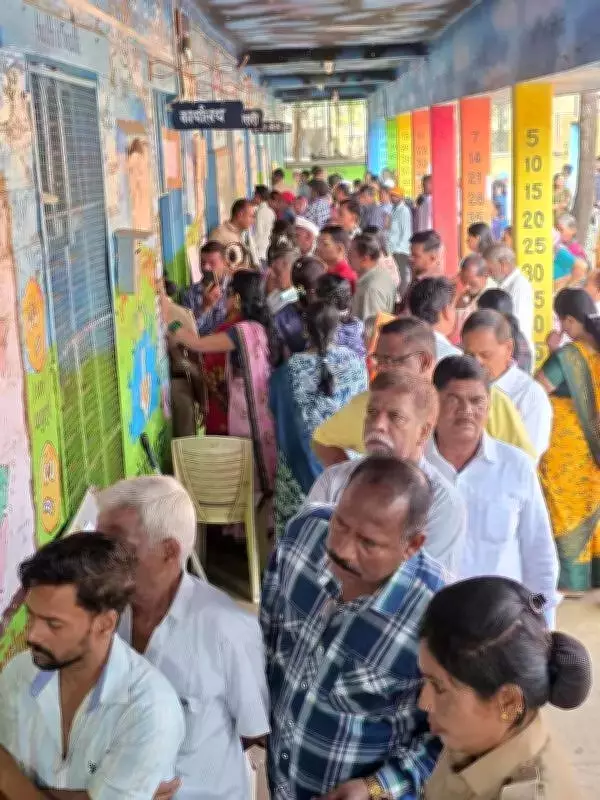
Maharashtra Rural Elections Witness Robust 65% Voter Participation
The elections for 12 zilla parishads and 125 panchayat samitis across Maharashtra on Saturday saw an impressive voter turnout, with state election commissioner Dinesh Waghmare projecting it to reach approximately 65%. This significant participation underscores the engagement of rural communities in the democratic process, reflecting a vibrant electoral landscape in the state.
District-Wide Turnout Figures Highlight Regional Variations
By 5:30 PM, Pune district emerged as a frontrunner with an estimated overall turnout of 68.89%. Within Pune, Velhe taluka led the charge with a remarkable 79.3% polling, while Baramati recorded 54.9%. Notably, five talukas—Velhe, Maval, Shirur, Bhor, and Khed—surpassed the 75% mark, and eight out of thirteen talukas achieved over 65% turnout. This pattern indicates higher voter participation in rural areas compared to semi-urban regions, highlighting a distinct demographic trend.
Data compiled until 3:30 PM revealed Kolhapur district leading with 58.81% turnout across its twelve talukas, followed closely by Raigad at 57.77%. Other districts showed varied figures: Parbhani at 55.71%, Chhatrapati Sambhajinagar at 51.52%, Sangli at 51.47%, Satara at 51.02%, and Pune at 51%. Sindhudurg, Dharashiv, and Latur recorded turnouts around 50%, while Ratnagiri and Solapur posted lower figures at 47.38% and 47.66%, respectively. These statistics provide a comprehensive overview of voter engagement across the state.

Peaceful Polling with Minor Technical Glitches
Polling remained largely peaceful across Maharashtra, with no major disruptions reported. However, technical issues were noted, particularly in Ratnagiri district, which saw the highest number of EVM replacements at 40 machines. State election commissioner Dinesh Waghmare attributed these failures to clock and link errors, assuring that a thorough inspection would be conducted post-counting to identify root causes. The use of traditional bottled indelible ink proceeded smoothly without complaints, ensuring the integrity of the voting process.
In contrast to the recent municipal council elections, which had a turnout of around 68%, and the 29 municipal corporation polls at 55%, this rural election demonstrates a strong commitment to local governance. The elections, held under the shadow of deputy chief minister Ajit Pawar's tragic death in an air crash last month, are viewed as a litmus test for NCP factions contesting in alliances, particularly in western Maharashtra strongholds.
Political Dynamics and Incidents During Polling
Deputy chief minister Sunetra Pawar and NCP (SP) politicians Jayant Patil and Rohit Pawar were among the early voters as polling commenced at 7:30 AM. Over 2.08 crore voters were eligible to exercise their franchise across the twelve districts: Pune, Satara, Sangli, Solapur, Kolhapur, Raigad, Ratnagiri, Sindhudurg, Chhatrapati Sambhajinagar, Parbhani, Dharashiv, and Latur.
Isolated incidents of tension were reported, such as in Karkamb village, Pandharpur, where NCP and BJP workers clashed, temporarily halting polling until additional police forces arrived. In Tasgaon's Chinchani village, supporters of NCP (SP) and NCP faced off, but a major clash was averted due to police intervention. Additionally, Shiv Sena (UBT) functionary Jaywant Vaydande was booked for allegedly damaging an EVM at Nadhawde polling booth in Kolhapur district, citing protest against EVMs and a demand for ballot paper voting.
Election Timeline and Administrative Details
The state election commission (SEC) announced these polls on January 13, with the Supreme Court granting a two-week extension beyond January 31. Following Ajit Pawar's death on January 28, the state government declared mourning from January 28 to 30, leading the SEC to postpone polling from February 5 to February 7. After results are declared, the model code of conduct will be lifted, and elected members' names will be published in the government gazette by February 11.

In Marathwada, polling in Chhatrapati Sambhajinagar, Parbhani, Dharashiv, and Latur districts was largely peaceful, with sporadic EVM-related issues. By the end of the day, Latur registered around 63.5% turnout, while Parbhani and Dharashiv recorded nearly 56% and 50%, respectively, until 3:30 PM. Chhatrapati Sambhajinagar reported 35% polling until 1:30 PM, with estimated figures by 5:30 PM reaching 65% in Chhatrapati Sambhajinagar, 74.35% in Kolhapur, and 67.18% in Solapur, pending final confirmation.
A total of 125 talukas participated in the polls for 731 zilla parishad seats and 1,462 panchayat samiti seats across the twelve districts, marking a significant event in Maharashtra's local governance framework. The overall turnout reflects a healthy democratic engagement, setting the stage for future political developments in the region.





