

Maharashtra's Rural Elections: A Crucial Democratic Exercise
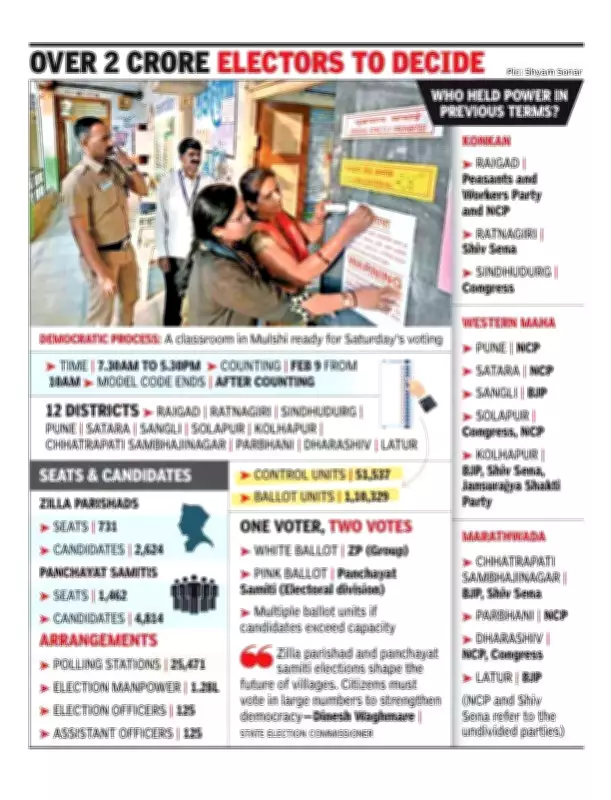
In a significant democratic event, the fate of thousands of candidates contesting for local governance positions in Maharashtra will be determined this Saturday through electronic voting machines. A total of 2,624 candidates are competing for 731 seats across 12 Zilla Parishads, while 4,814 aspirants are vying for 1,462 seats in 125 Panchayat Samitis. The State Election Commission has confirmed that approximately 2.08 crore voters are eligible to participate in these elections, highlighting the scale of this grassroots political process.
Addressing Duplicate Voter Entries
A notable challenge in this election cycle is the presence of duplicate names or entries in the Zilla Parishad electoral rolls. For instance, Pune Zilla Parishad has identified around 67,000 such duplicate entries, and Sangli ZP rolls contain nearly 60,000 similar instances. Election officials have clarified that voters with duplicate entries, marked by two asterisks next to their names, will be permitted to cast their vote only once. Additionally, these voters will be required to submit a formal undertaking confirming that they did not participate in recently held Nagar Parishad, Nagar Panchayat, or municipal corporation elections.
An election official explained, "There is a possibility that voters who participated in other recent elections may attempt to vote again in the ZP and panchayat samiti polls. The State Election Commission has directed us to cross-check and remove duplicate names appearing in both municipal corporation and ZP rolls, but this task remains incomplete due to logistical constraints."

Historical Context and Political Significance
The three-tier Panchayati Raj system, which includes Zilla Parishads at the district level, Panchayat Samitis at the block level, and Gram Panchayats at the village level, was first introduced by Rajasthan in 1959 and later adopted by other states. Maharashtra implemented this system in 1961 through the Maharashtra Zilla Parishads and Panchayat Samitis Act. These rural bodies play a vital role in village-level development and are politically significant, as many grassroots party workers begin their careers here before rising to prominent positions, including ministerial or chief ministerial roles.
Election Procedures and Innovations
The State Election Commission has introduced colored ballots for these elections to ensure clarity and reduce confusion. White ballots are designated for Zilla Parishad candidates, while pink ballots are used for Panchayat Samiti aspirants. Each voter is required to cast two separate votes—one for a ZP representative and one for a Panchayat Samiti representative. For most of the 12 Zilla Parishads, these elections are being conducted after a four-year gap, adding to their importance.
Logistical Arrangements and Security Measures
District authorities have declared a public holiday for schools on polling day, as headmasters, teachers, supervisors, and non-teaching staff have been assigned election duties. To maintain order, the sale of liquor is prohibited on polling day and on the day of vote counting, which is scheduled for Monday. Prohibitory orders will be enforced within a 200-meter radius of polling stations, and the use of cellphones inside voting booths is strictly banned to prevent any misconduct.
Election staff have already departed for their respective polling stations, with teams assigned to remote booths leaving earlier than others to ensure timely setup. These teams have been equipped with communication devices to stay connected with the nearest election office in case of emergencies, ensuring smooth operations even in isolated areas.
Health and Safety Protocols
In accordance with State Election Commission directives, district administrations have deployed medical teams at polling stations to address any health concerns. Ambulances will also be on standby to transport poll staff to the nearest hospitals in case of medical emergencies, prioritizing the well-being of all participants in this extensive electoral process.






