

Maharashtra Local Body Elections Witness Robust 68.28% Voter Participation
The State Election Commission (SEC) has announced that the elections for 12 Zilla Parishads (ZP) and 125 Panchayat Samitis (PS) in Maharashtra concluded with an overall voter turnout of 68.28% on Saturday. This significant democratic exercise saw 1.41 crore voters out of a total eligible electorate of 2.07 crore casting their ballots for 731 ZP seats and 1,462 PS seats.
District-Wide Turnout Analysis Reveals Strong Rural Engagement
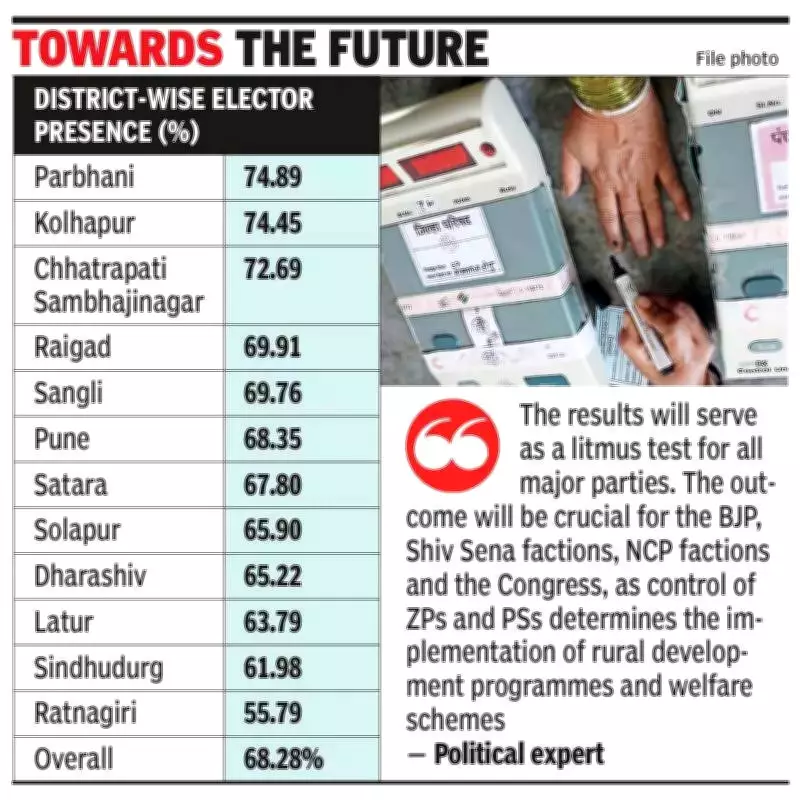
According to the final data released by the SEC, Parbhani district registered the highest voter participation across all 125 talukas at an impressive 74.89%. It was closely followed by Kolhapur district with 74.45% and Chhatrapati Sambhajinagar district at 72.69%. Notably, three out of the twelve districts that went to polls recorded turnout figures above the 70% mark.
Six districts fell within the 65% to 70% range, while three districts remained below 65%. In certain talukas, particularly within Kolhapur district, voter participation soared to as high as 80%, indicating exceptionally strong civic engagement in those areas.

Extended Voting Hours and Historical Context
SEC Chief Dinesh Waghmare reported that voting extended beyond the scheduled time in several interior rural regions. "Citizens were already in queues before 5:30 PM, and therefore, voting continued till late in some areas," he stated. Waghmare further noted that "voting percentages for ZP polls are traditionally high, a trend consistent with earlier local body elections."
This turnout compares favorably with other recent local body elections in the state. While municipal council elections recorded approximately 68% participation, elections to 29 municipal corporations averaged only 55%. This disparity suggests stronger voter engagement in rural local governance compared to urban civic bodies, as highlighted by poll experts.
Gender Parity and Voter Demographics
The elections demonstrated notable progress toward gender parity in electoral participation. Male voters registered a slightly higher turnout rate of 69.6%, compared to 66.8% among female voters. However, the voter registration numbers tell a more balanced story: female voter registration stood at 1.01 crore, nearly at par with male registration of 1.06 crore.
In terms of absolute numbers, 74.06 lakh men and 67.84 lakh women exercised their franchise, reflecting a healthy and inclusive democratic process.
Political Significance and Electoral Context
These local body elections were keenly observed for their political implications, particularly regarding the future direction and unity of the Nationalist Congress Party (NCP). Factions of the NCP contested in alliance in parts of western Maharashtra, making the outcomes a critical indicator of intra-party dynamics.
The elections, originally scheduled for February 5, were postponed to February 7 following the death of senior leader Ajit Pawar and the subsequent declaration of three days of state mourning.
Polling was conducted across twelve districts: Raigad, Ratnagiri, Sindhudurg, Pune, Satara, Sangli, Solapur, Kolhapur, Chhatrapati Sambhajinagar, Parbhani, Dharashiv, and Latur.
Results as a Litmus Test for Major Parties
Political analysts emphasize that the results will serve as a crucial litmus test for all major political parties in Maharashtra. "The outcome will be vital for the BJP, Shiv Sena factions, NCP factions, and the Congress," explained an expert. "Control of Zilla Parishads and Panchayat Samitis directly influences the implementation of rural development programs and welfare schemes, making these elections strategically important."

Counting Schedule and Next Steps
Election officials have confirmed that the counting of votes will take place on February 9 at taluka-level centers, commencing from 10:00 AM. Following the completion of the counting process, the model code of conduct will be lifted, allowing normal administrative activities to resume across the concerned districts.
The high voter turnout and the competitive nature of these elections underscore the significance of grassroots democracy in shaping Maharashtra's political and developmental landscape.





