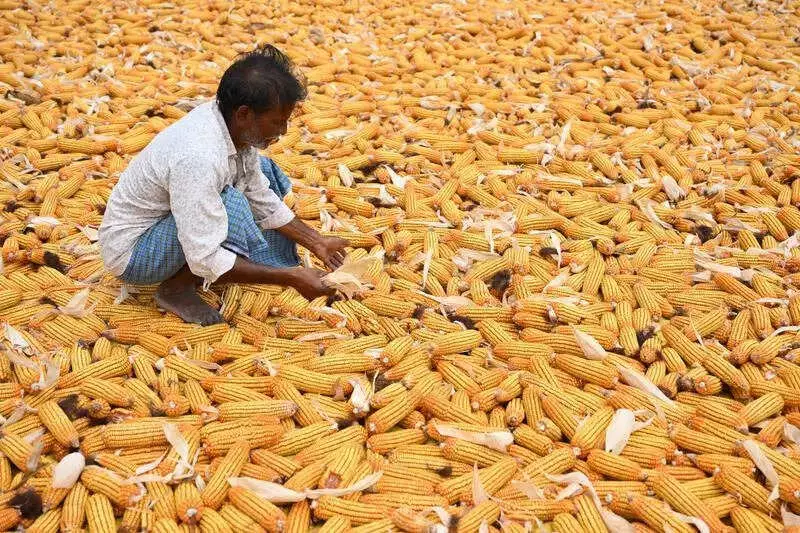
The Karnataka government's Minimum Support Price (MSP) scheme for maize has hit a significant logistical roadblock, leading to a notable failure in its implementation. The core issue stems from the establishment of procurement centres far from major maize-producing regions, forcing farmers to bear high transportation costs that effectively nullify the benefit of the support price.
Procurement Plan and Farmer Registration
This season, Karnataka produced a substantial 54 lakh tonnes of maize. In response to a steep decline in market prices, the state government announced it would purchase up to 50 quintals from each farmer at Rs 2,400 per quintal. The statewide procurement target was set at 7 lakh tonnes.
Following government directives, the Karnataka Milk Federation (KMF) established five procurement centres across the state. These were located in Gubbi, Shikaripura, Dharwad, Hassan, and Rajanukunte in Bengaluru. The process required farmers to register online via agriculture department, e-governance, or NIC portals to receive an SMS with their procurement schedule.

Registration numbers highlighted significant interest from key maize-growing districts:
- Ballari: 42 farmers registered to sell 771.12 quintals.
- Koppal: 323 farmers offered 6,447.8 quintals.
- Vijayanagara: 479 farmers registered 6,128 quintals.
The Dharwad Dilemma and Farmer Backlash
Despite the registrations, a major flaw emerged. Farmers from districts like Koppal, Ballari, and Vijayanagara were assigned to the distant Dharwad procurement centre, not within their local RABAKOVI Milk Federation area. The requirement to transport produce to Dharwad at their own cost proved prohibitive.
Basavaraj Maradi, a maize farmer from Yelburga taluk in Koppal district, voiced the collective frustration: "The procurement centres should have been established within the RABAKOVI Milk Federation of KMF. The government has not fulfilled this obligation, undermining the basic objective of the MSP. If we incur transportation costs, we will end up with nothing."
Consequently, many farmers, including those from Raichur district, opted out of the process entirely. The high transportation expense has driven numerous growers to sell their maize to local private traders instead, defeating the purpose of the MSP safety net.
Official Procedure and Broader Criticism
Officials from the RABAKOVI Milk Union have collected crop samples from registered farmers for quality analysis at the Dharwad KMF centre. The KMF has stated it will only purchase crops meeting specific standards, such as a moisture content not exceeding 14%.
Madhav Reddy, President of the State Farmers' Association and Hasiru Sene, strongly criticized the government's approach. He emphasized that procurement must happen near the production area to be effective. "If farmers are responsible for transportation costs, they will be left with nothing," Reddy stated, highlighting how the flawed logistics are pushing farmers towards the private market.
This situation underscores a critical gap between policy announcement and ground-level execution. The failure to align procurement centre locations with production hubs has rendered the MSP initiative ineffective for many maize cultivators in North Karnataka, raising serious questions about the planning of agricultural support schemes.