

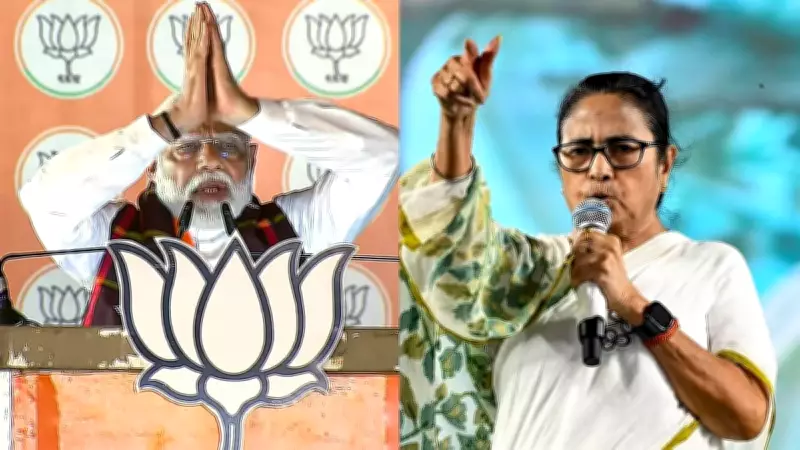
West Bengal Chief Minister Mamata Banerjee Criticizes PM Modi's 'Swami' Prefix Usage
In a recent political development, West Bengal Chief Minister Mamata Banerjee has strongly criticized Prime Minister Narendra Modi for his use of the prefix 'Swami' in a message commemorating the birth anniversary of Sri Ramakrishna. The controversy erupted after PM Modi shared a social media post honoring the revered spiritual figure, which Banerjee alleges is a deliberate attempt to politicize religion for electoral gains in the state.
Details of the Controversial Message
Prime Minister Narendra Modi posted a message on social media platforms to mark the birth anniversary of Sri Ramakrishna, a 19th-century mystic and saint from West Bengal. In his post, Modi referred to the saint as 'Swami Ramakrishna,' incorporating the honorific title 'Swami,' which is traditionally used for ascetics and spiritual leaders. The Prime Minister's message emphasized Ramakrishna's teachings of harmony and universal brotherhood, aligning them with broader national values.
However, Mamata Banerjee, the Chief Minister of West Bengal and a key political opponent, swiftly responded with sharp criticism. She accused PM Modi of misusing religious sentiments and titles for political purposes, particularly in the context of West Bengal's sensitive socio-political landscape. Banerjee argued that such actions undermine the secular fabric of the nation and are aimed at influencing voters ahead of upcoming elections.

Mamata Banerjee's Accusations and Political Context
In her statement, Mamata Banerjee highlighted that the use of 'Swami' is not merely a linguistic choice but a calculated move to appeal to religious sentiments. She pointed out that Sri Ramakrishna is widely revered in West Bengal, and his legacy is often invoked in cultural and spiritual discourses. By attaching the prefix, Banerjee claims, Modi is attempting to co-opt this legacy to bolster the Bharatiya Janata Party's (BJP) image in the state, where it has been striving to expand its influence.
Banerjee further alleged that this incident is part of a broader pattern where the BJP leverages religious symbols and figures to advance its political agenda. She emphasized that such tactics divert attention from pressing governance issues, such as economic challenges and social welfare, and instead foster divisiveness. The Chief Minister called for a focus on substantive policy matters rather than symbolic gestures that risk polarizing communities.
Reactions and Broader Implications
The controversy has sparked reactions from various political quarters and observers. Supporters of Mamata Banerjee and her Trinamool Congress party have echoed her concerns, viewing Modi's message as an intrusion into West Bengal's cultural domain. On the other hand, BJP leaders have defended the Prime Minister, stating that his message was a genuine tribute to a great spiritual leader and should not be politicized.
This incident underscores the ongoing tensions between the ruling Trinamool Congress and the opposition BJP in West Bengal, a state known for its vibrant political dynamics. It also raises questions about the intersection of religion and politics in India, where leaders often navigate complex identities and histories to connect with voters. As the debate continues, it highlights the delicate balance between honoring cultural heritage and avoiding its exploitation for electoral advantages.
In summary, Mamata Banerjee's criticism of PM Modi's use of 'Swami' in his Ramakrishna birth anniversary message reflects deeper political rivalries and concerns over the politicization of religion. The episode adds to the charged atmosphere in West Bengal's political scene, with potential implications for future electoral strategies and public discourse.






