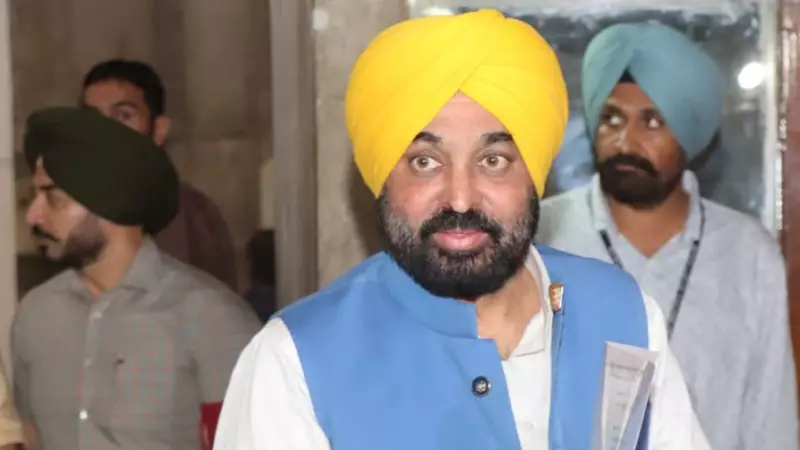
Punjab Chief Minister Bhagwant Mann has firmly defended his government's investigation into the disappearance of 328 sacred copies, or 'saroops', of the Guru Granth Sahib, stating it is a legal obligation. This stance comes amidst strong opposition from the Shiromani Gurdwara Parbandhak Committee (SGPC) and top Sikh clergy, who have accused the Aam Aadmi Party (AAP) government of meddling in internal religious affairs.
Clash Over Jurisdiction and Religious Autonomy
Mann's public statement on Monday followed a significant warning issued a day earlier by the five Singh Sahiban, led by Akal Takht's officiating Jathedar, Giani Kuldip Singh Gargajj. The clergy had demanded that the AAP administration cease interference in Sikh matters or face action as per Panthic traditions. The core of the dispute lies in whether a state government can legally intervene in a case involving sacred religious texts held by a body like the SGPC.
The Chief Minister categorically rejected allegations of overreach. "This is not interference in religious matters. The government has the legal right to investigate the missing 'saroops'," Mann asserted during a press briefing in Chandigarh. He expressed grave concern for the safety of the holy books, fearing potential desecration, and emphasized that the police are invariably called upon when sacrilege incidents occur.

The Case of the Missing Saroops and the FIR
The controversy stems from the discovery in June 2020 that 328 saroops were missing from the SGPC's publication house in Amritsar. On December 7, 2025, the Amritsar police registered an FIR against 16 individuals, including a former chief secretary of the SGPC, in connection with the case. A Special Investigation Team (SIT) was also formed by the state government.
Mann stated that the probe was initiated as a "moral responsibility" after appeals from the Sikh community and Panthic organizations. He questioned how filing an FIR to locate the scriptures constituted interference. "The sangat wants to know where those holy books are," he said, urging the SGPC to cooperate with the investigation.
However, SGPC president Harjinder Singh Dhami accused the CM of attempting to mislead the community and politicize the issue. Dhami referenced the Sunday meeting of the Singh Sahiban, which directed against political exploitation of the matter. He promised to present complete facts to the community on Tuesday.
Historical Resolutions and Political Undertones
In his defense, Mann presented copies of SGPC resolutions from 2020 that he claimed indicted several officials and employees for the disappearance. He highlighted that resolutions in July, August, and September of that year had called for legal action, termination of services, and withholding of benefits for those found responsible.
Mann pointedly mentioned SGPC accountant Satinder Singh Kohli, noting his services were to be terminated and records obtained from him within 15 days as per a 2020 resolution. He also revealed that Kohli serves as an accountant for Shiromani Akali Dal (SAD) president Sukhbir Singh Badal, injecting a clear political dimension into the argument. Mann alleged that the subsequent dilution of these resolutions in September 2020 amounted to a cover-up.
The CM criticized the Akali Dal, recalling its legacy as a "party of lions" in 1920 but labeling its current leadership as "dinosaurs" more interested in power than Punjab's welfare. He also questioned the authority of officiating Jathedar Giani Gargajj, stating he is not recognized by several Sikh institutions and is being used as a "shield."
Mann affirmed that all individuals named in the FIR would be summoned and vowed that the government would ensure those responsible are punished under the law. The SGPC maintains that the FIR challenges the Akal Takht's authority and constitutes unwarranted interference in its administrative rights, setting the stage for a continued legal and theological standoff.