

PM Modi Counters TMC's 'Anti-Non-Veg' Narrative with Fish Production Critique
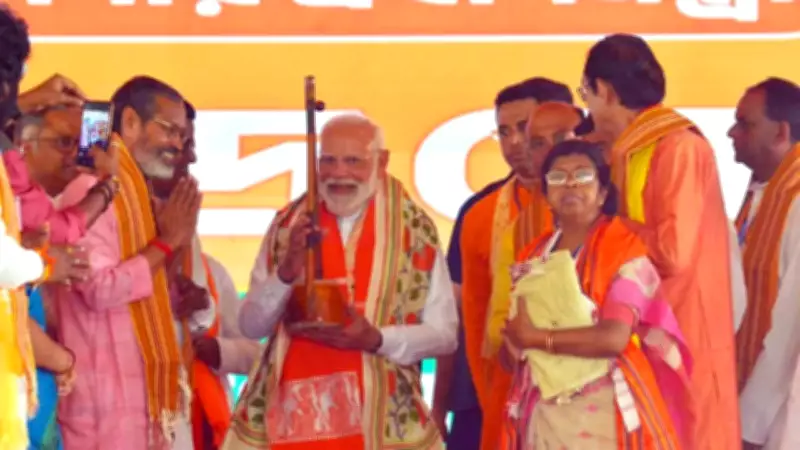
Prime Minister Narendra Modi launched a sharp counterattack on Thursday against the Trinamool Congress's portrayal of the Bharatiya Janata Party as "an anti-non-vegetarian party" in West Bengal, a state renowned for its deep cultural and culinary affinity for fish, particularly maachh-bhaat (fish and rice). Speaking at a rally in Haldia, the first of three public meetings scheduled for the day, Modi turned the tables by accusing the ruling TMC government of failing to ensure adequate fish supply for the people of Bengal, forcing the state to rely on imports from other regions.
Contrasting Records: Centre's Fisheries Push vs. State's Shortfalls
"Trinamool in 15 years could not even give you fish. We have created a separate ministry for fisheries," Modi declared, highlighting the BJP-led central government's establishment of a dedicated Ministry of Fisheries, Animal Husbandry, and Dairying. He contrasted this proactive approach with what he described as Bengal's persistent inadequacy in achieving self-sufficiency in fish production.
Drawing parallels with other states, Modi pointed out that Bihar and Assam had previously faced similar challenges, requiring fish imports to meet local demand. "Now they have become self-sufficient and their fish production has doubled," he noted, framing their success as a model for Bengal. The Prime Minister made a direct electoral promise, asserting, "Bengal, too, will become self-reliant if BJP is voted to office."

Context of the Political Clash Over Food and Culture
Modi's remarks come in response to repeated allegations by West Bengal Chief Minister Mamata Banerjee, who has warned on multiple occasions that a BJP victory in the state assembly polls would lead to restrictions on non-vegetarian food, including fish. Banerjee has cited examples from other BJP-ruled states to bolster her claim, positioning the issue as a matter of cultural preservation and dietary freedom for Bengal's populace.
However, central data reveals a more nuanced picture. West Bengal stands as India's second-largest fish-producing state, trailing only Andhra Pradesh. Provisional figures for the 2024-2025 period indicate Bengal's fish production at approximately 23.7 lakh tonnes, with the bulk of this output—over 20 lakh tonnes—stemming from the state's robust inland fisheries and aquaculture sectors.
Despite this significant domestic production, fish remains a staple diet and a primary source of protein for a large segment of Bengal's population. To satisfy the high demand, the state imports a substantial quantity, around 1.2 lakh tonnes in 2024-2025, from states like Andhra Pradesh and Bihar. This import dependency provided the backdrop for Modi's critique of the TMC's governance.
Broader Political Themes: From Fish to Fear and Trust
After addressing the fish production issue, Modi pivoted to broader campaign themes central to the BJP's electoral strategy in Bengal. He framed the political choice as one between the Trinamool Congress's rule of "fear" and the "trust" that people place in the BJP. In a charged rhetoric, he described the state under TMC as a "factory of infiltrators and bombs," allegations that have been recurrent in the BJP's narrative against the ruling party.
The exchange underscores how food, culture, and governance are intertwined in the high-stakes political battle for West Bengal. Modi's focus on fish production not only counters the TMC's dietary restriction allegations but also seeks to highlight economic and agricultural failures, positioning the BJP as a party capable of delivering self-sufficiency and prosperity. As the assembly elections approach, such issues are likely to remain at the forefront of political discourse, reflecting the deep-seated connections between policy, plate, and power in the state.






