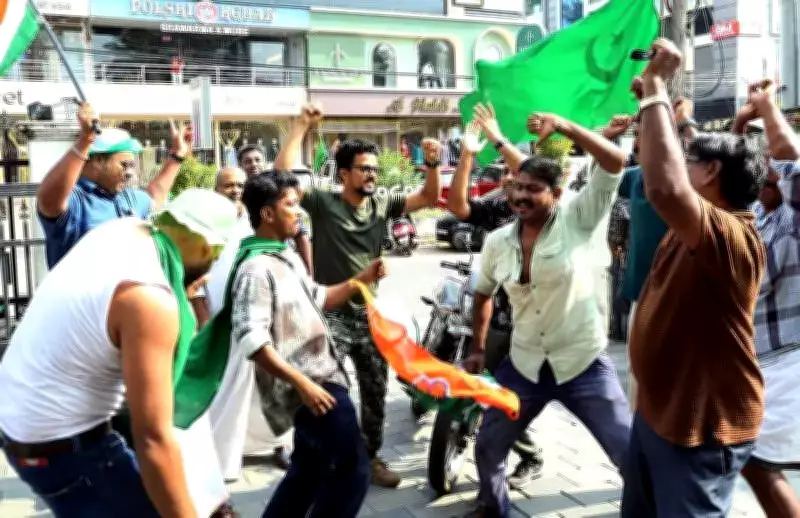
A near-en bloc consolidation of Muslim and Christian minority votes, along with widespread anti-incumbency, emerged as the decisive force behind the United Democratic Front's (UDF) massive victory in the 2026 Kerala assembly elections. This outcome delivered a crippling setback to the Left Democratic Front (LDF) and reshaped Kerala's political landscape.
Minority Consolidation Reverses 2021 Trends
The verdict marks a dramatic return of minority communities, long the social backbone of the UDF since its formation in the 1970s. It decisively reverses the inroads the LDF had made among these groups in the 2021 elections. The scale of the shift was most visible in Malabar, where the UDF won 38 of the 44 constituencies where Muslims comprise roughly 25 to 30 percent or more of the electorate. In central and southern Kerala, the trend held equally firm, with the UDF securing eight of the 10 constituencies where Muslim voters wield significant influence. With Muslims accounting for approximately 27 percent of Kerala's population in the 2011 Census and estimated at nearly 30 percent today, the consolidation proved electorally decisive.
From Drift to Wave
The results confirm that what began as a perceptible drift in the 2024 Lok Sabha elections and sharpened in the 2025 local body polls has now culminated in a full political wave. The UDF's focal talking point of an alleged Communist Party of India (Marxist)-Bharatiya Janata Party (CPM-BJP) deal added to the momentum. The LDF's attempts to counter this through tactical alignments with the Social Democratic Party of India (SDPI) yielded no dividends and proved counterproductive in several constituencies. Efforts to engineer counter-polarisation by highlighting the UDF's alleged links with Jamaat-e-Islami similarly failed to gain traction and, in many instances, backfired. The perceived SDPI engagement also blunted the LDF's attack on the Jamaat-e-Islami issue, while the party's inability to clearly state whether it viewed the SDPI as an extremist organisation left its leadership politically exposed.

Breakdown of the 2021 Compact
In 2021, the LDF had successfully drawn sections of minority voters by positioning itself as the primary bulwark against majoritarian politics, backed by its strong stance on the Citizenship Amendment Act and consistent welfare delivery. That compact has now decisively broken down. The unravelling had begun earlier. During the 2024 parliamentary elections, the LDF's aggressive minority outreach was already drawing questions about political sincerity. Controversies, including an alleged 'Kafir' social media episode and a campaign video widely criticised as Islamophobic in Kasaragod, deepened unease within the community. By the time of the assembly elections, these had crystallised into a broader trust deficit.
Perception of Majority Appeasement
At the heart of this disenchantment was a growing perception that the CPM had recalibrated its political compass toward majority appeasement. This view, widespread across minority-dominated regions, proved electorally costly for the Left. The CPM leadership's visible proximity to SNDP general secretary Vellappally Natesan, whose controversial remarks had unsettled sections of the Muslim community, became a significant talking point. The absence of any strong condemnation from the CPM leadership further alienated minority voters.
Allies Fail to Deliver
Support from smaller outfits such as the SDPI, the People's Democratic Party (PDP), and the Indian National League (INL) failed to translate into votes for the LDF. Notably, the AP Sunni faction led by Kanthapuram A P Aboobacker Musliyar, a traditional Left ally, chose to stay publicly neutral, having sensed the shifting mood within the community well in advance.
The 2026 Kerala election results underscore the critical role of minority vote consolidation in determining electoral outcomes. The UDF's victory not only marks a return of its traditional support base but also highlights the LDF's failure to retain minority trust amid controversies and strategic missteps.