

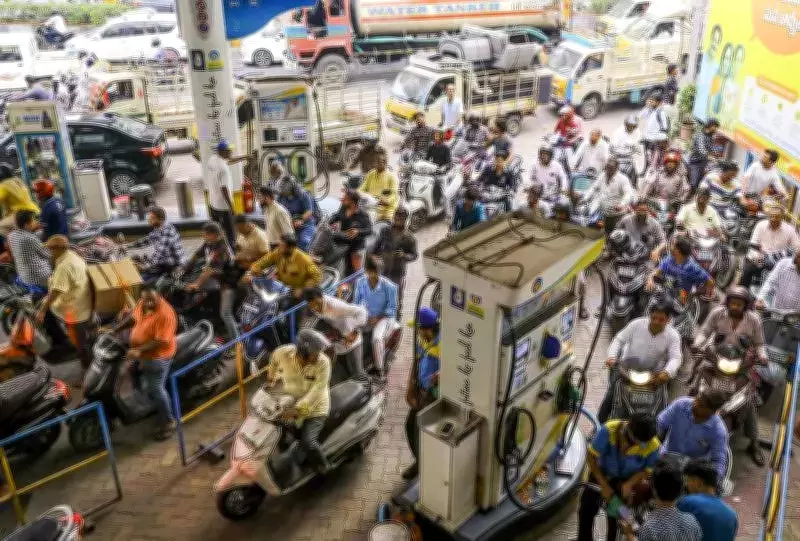
Nagpur Fuel Crisis: Panic Buying Creates Kilometer-Long Queues and Widespread Disruption
In the early hours of Wednesday morning, the city of Nagpur awoke to a scene of growing desperation as hundreds of motorists formed serpentine queues outside petrol pumps, their vehicles inching forward under the dim pre-dawn light. The routine act of refueling had transformed overnight into a grueling struggle, with the specter of empty tanks looming over the city's daily rhythm.
Dawn Queues and Desperate Measures
By 5 a.m., individuals like Vaibhav Kurhekar were already positioned in lines that stretched far down the road, joined by night-shift workers still in office attire, commuters clutching tiffin boxes, and anxious drivers repeatedly checking their fuel gauges. Despite official assurances from the district administration denying any fuel shortage, panic buying intensified for the third consecutive day, overwhelming the city's fuel distribution network.
To manage the surging demand, petrol pumps implemented strict rationing measures. Two-wheeler riders were limited to fuel worth ₹100 to ₹200, while car owners could purchase only around ₹1,000 worth of petrol. These restrictions, however, did little to quell the chaos as arguments erupted over line-jumping and pumps abruptly ran dry, leaving staff struggling to maintain order.

City-Wide Chaos and Economic Impact
Across Nagpur's major localities, vehicles began lining up well before sunrise, their owners hoping to secure a few precious liters before supplies vanished. By mid-morning, queues at many pumps extended up to a kilometer, with motorists frantically moving from one station to another, often wasting the little fuel remaining in their tanks in the futile search.
The crisis inflicted significant economic and personal costs. Office-goers lost hours before their workday even began, while delivery workers, auto-rickshaw drivers, and small traders bore the brunt of the disruption. "I left home at 5:15 a.m. thinking I would finish quickly and go to work. But many others were also waiting in line for the pump to open," recounted Kurhekar, who spent nearly an hour in a queue.
Operational Breakdown and Allegations
Numerous petrol pumps remained shuttered throughout the morning, and those that opened were forced to close by early afternoon after exhausting their stocks. "There were already long queues when our petrol pump opened at 6 a.m. We supplied fuel till 1 p.m. before shutting down. The next stock is expected at 8 p.m.," explained Ganesh Naktode, a pump worker in Surendra Nagar.
Only a handful of outlets managed to operate throughout the day, and even these imposed strict rationing to control demand. Petrol pump employees reported that demand had more than doubled within two days due to panic buying. "On an average, we sell around 5,000 liters daily. On Tuesday, it crossed 13,000 liters. Even today, the demand is very high. People are filling fuel even if they already have enough, fearing it may not be available tomorrow," stated Madhukar Damedar, an employee at the Narendra Nagar pump.
Payment Issues and Broader Concerns
In several areas, citizens waited for hours outside closed petrol pumps, hoping for the arrival of fresh tankers. Some commuters alleged that certain pumps insisted on cash transactions, while others experienced prolonged delays with digital payments. "I checked three petrol pumps, including in Mihan and on Wardha Road, but they were closed. When I finally found one that had fuel, I had to wait a long time and then struggle with payment," shared Yash Vargantiwar, an IT professional.
Transporter Kukku Marwah warned that fuel prices might rise in the coming days, potentially impacting the cost of essential commodities. He also accused some petrol pump operators of exploiting the situation through questionable supply practices and called for immediate intervention by the authorities.
Even as some pumps received fresh stock later in the day, the overall situation remained tense, with demand far outstripping supply. The crisis underscored the fragility of urban fuel logistics and the rapid escalation of public anxiety in the face of perceived scarcity.






