Nagpur Municipal Corporation Grapples with Severe Revenue Shortfall as Fiscal Year Nears End
The Nagpur Municipal Corporation (NMC) is confronting a significant financial challenge, having raised merely Rs2,680.27 crore in revenue during the first ten months of the current financial year. This figure starkly contrasts with an ambitious budget target of Rs5,565 crore, resulting in the civic body achieving barely 48% of its projected receipts. With only one month remaining before accounts close on March 31, the corporation is all but certain to miss its annual revenue benchmark by a wide margin, highlighting critical issues in fiscal management and planning.
Structural Imbalance and Grant Dependence Exposed in Receipt Data
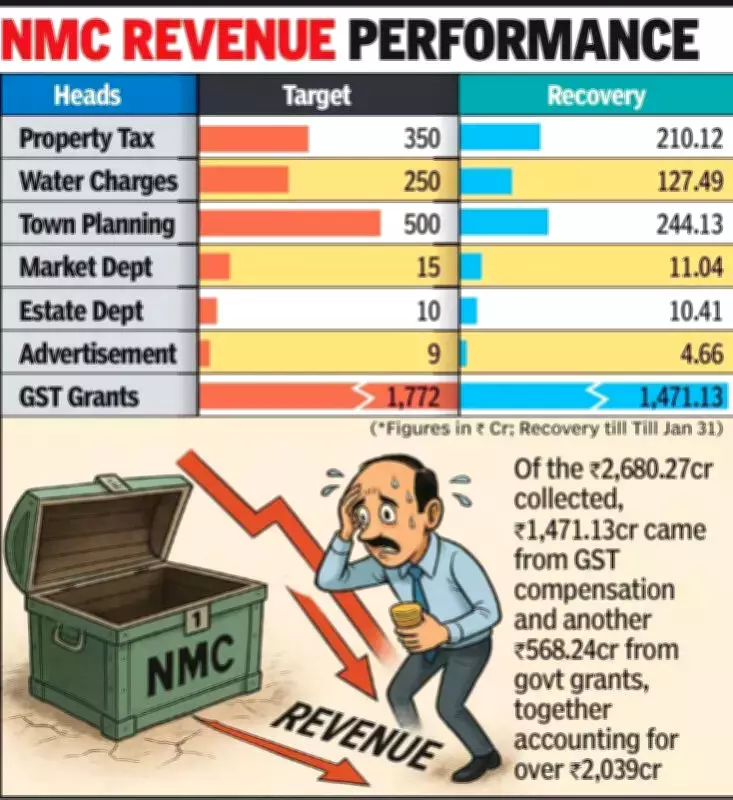
The receipt statement up to January 31 reveals a profound structural imbalance in NMC's finances. Of the total Rs2,680.27 crore collected, a substantial Rs1,471.13 crore originated from GST compensation, while another Rs568.24 crore came from government grants. Together, these grant-driven sources account for over Rs2,039 crore, meaning that nearly 76% of the revenue so far is dependent on external funding rather than internal generation. This heavy reliance underscores a vulnerability in the corporation's financial sustainability, as it fails to diversify its revenue streams effectively.
Internal Revenue Heads Fall Short of Ambitious Targets
Key internal revenue heads have consistently underperformed against their targets, exacerbating the fiscal gap. Property tax, which was projected to bring in Rs350 crore, fetched only Rs210.12 crore by the end of January. Similarly, water charges stood at Rs127.49 crore against a target of Rs250 crore, indicating a significant shortfall in utility-based income. The town planning department, expected to generate Rs500 crore through building permissions and development-related approvals, realized just Rs244.13 crore, falling short of even the halfway mark and reflecting delays in construction activities or administrative inefficiencies.
Other departments also struggled to meet their goals. Advertisement revenue, pegged at Rs9 crore for the year, yielded Rs4.66 crore so far, while the market department collected Rs11.04 crore against a Rs15 crore target. In a slight positive note, the estate department marginally exceeded its Rs10 crore goal with Rs10.41 crore in receipts. However, these minor successes are overshadowed by the overall trend of underperformance across most revenue categories.
Widening Fiscal Gap and Implications for Future Budgeting
To meet the full budgeted receipts of Rs5,565 crore, NMC would need to mobilize nearly Rs2,885 crore in the remaining month, an improbable target without substantial last-minute grant releases or unprecedented revenue surges. This widening fiscal gap raises uncomfortable questions about the corporation's financial planning and long-term sustainability. When Municipal Commissioner Abhijeet Chaudhari presented the budget, he refrained from imposing new taxes, banking instead on improved recovery efficiency and expansion of the tax base. Yet, four years into administrator-led governance, there has been no significant diversification of revenue sources or innovative monetization of civic assets, such as public spaces or digital services.
The timing is crucial, as Chaudhari is set to present the revised budget for 2025-26 along with the proposed outlay for the next financial year before the standing committee in March. This financial performance indicates that the civic body may struggle to fund mounting infrastructure demands and pending civic works, casting a long shadow over the upcoming fiscal blueprint. The continued dependence on state largesse, rather than strengthening its own revenue base, could hinder NMC's ability to address urban development needs effectively, from road repairs to water supply enhancements.
Broader Context and Expert Analysis
This revenue shortfall occurs after four years of administrator rule, a period marked by centralized decision-making that may have impacted local revenue generation initiatives. Experts suggest that without proactive measures, such as leveraging technology for tax collection or exploring public-private partnerships, NMC's financial health could deteriorate further. The situation calls for a reassessment of budget assumptions and a more realistic approach to setting targets, considering economic conditions and recovery capacities.
As the revised estimates are tabled this month, stakeholders, including citizens and policymakers, will be closely watching how NMC plans to bridge this gap and ensure fiscal responsibility in the coming year. The corporation's inability to meet its revenue goals not only affects immediate operations but also risks delaying critical projects that impact the quality of life in Nagpur, from sanitation to public transportation improvements.