Nagpur Municipal Corporation Faces Property Tax Revenue Crisis Amid Compliance Failures
The Nagpur Municipal Corporation (NMC) is grappling with a significant downturn in property tax revenue for the fiscal year 2025-26, despite a steady increase in the number of properties within its jurisdiction. This alarming trend has exposed deep-seated cracks in tax compliance and recovery mechanisms, posing serious financial challenges for the cash-strapped civic body.
Sharp Decline in Collections Despite Property Growth
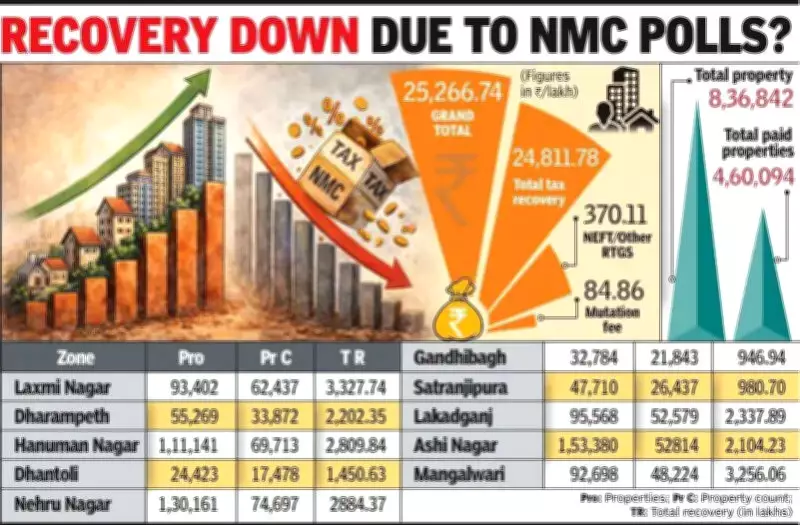
So far in 2025-26, the NMC has collected only Rs252.66 crore in property tax, a sharp drop from the Rs306 crore collected in the previous fiscal year, 2024-25. This decline is particularly concerning as it occurred during a period when the total number of properties in Nagpur climbed to 8,36,842, indicating that revenue growth is failing to keep pace with urban expansion. More worryingly, out of this total, only 4,60,094 property owners have paid their taxes, leaving a staggering 3.76 lakh properties either defaulting or remaining outside the tax net entirely.
Property Tax as a Critical Revenue Source
Property tax remains the single largest source of revenue for the Nagpur Municipal Corporation, making this shortfall a matter of grave concern. For 2025-26, the department initially set a target of Rs350 crore, which was later revised upwards to Rs400 crore, further widening the gap between expectations and actual collections. This revenue crisis threatens to undermine the civic body's ability to fund essential services and infrastructure projects.

Impact of Civic Election Cycle on Recovery Operations
Officials attribute part of the slowdown to disruptions caused by the civic election cycle. During peak collection months in December and January, most zonal teams were diverted towards election preparedness and poll-related duties, severely impacting field-level enforcement efforts. "In January 2024, the NMC collected around Rs30 crore, but this year it dropped drastically to just Rs6 crore," an official revealed, highlighting the direct correlation between election activities and tax recovery performance.
Breakdown of Revenue Sources
Of the total recovery so far, Rs248.11 crore has come from property tax, while Rs84.86 lakh was collected through NEFT/RTGS transactions and Rs3.70 crore via mutation fees. This breakdown underscores the overwhelming reliance on property tax as the primary revenue stream for the municipal corporation.
Zone-Wise Data Reveals Uneven Performance and Weak Enforcement
An analysis of zone-wise data exposes significant disparities in tax compliance and recovery across Nagpur:
- Laxmi Nagar leads with 62,437 taxpayers out of 93,402 properties, contributing Rs33.27 crore, yet nearly one in three property owners remains non-compliant.
- Dharampeth follows with 33,872 payers and Rs22.02 crore in recovery, but similar gaps persist.
- Ashi Nagar, with the highest property base of 1.53 lakh, shows only 52,814 payments, reflecting a poor 34% compliance rate and recovery of Rs21.04 crore.
- Nehru Nagar, with over 1.30 lakh properties, has just 74,697 taxpayers, contributing Rs28.84 crore, again pointing to a significant compliance gap.
Other zones such as Satranjipura, Gandhibagh, Lakadganj, and Hanuman Nagar continue to hover around the 50-60% compliance mark, underlining a systemic failure in tax collection mechanisms that spans the entire city.
Systemic Challenges and Future Implications
The persistent low compliance rates across multiple zones suggest deep-rooted issues in enforcement and taxpayer engagement. This revenue shortfall not only jeopardizes the NMC's financial stability but also raises questions about the effectiveness of current tax collection strategies. As Nagpur continues to grow, addressing these compliance gaps will be crucial for ensuring sustainable urban governance and adequate funding for public services.