

As dawn breaks over Pune, a unique and intense ritual unfolds outside party offices, far removed from the usual morning calm. Hundreds of men and women, files in hand and phones buzzing with data, queue up not for jobs but for a chance to enter city politics. This is the new, formalised gateway to securing a party ticket for the upcoming Pune and Pimpri-Chinchwad municipal corporation elections.
The Interview Revolution in Candidate Selection
Faced with an overwhelming number of aspirants and limited tickets, major political parties have moved beyond traditional parameters like popularity, seniority, or financial clout. They have instituted a rigorous, interview-based selection process. This method is now standard operating procedure for the BJP, NCP, Congress, and Shiv Sena.
The process is systematic: application forms are distributed in bulk, submitted by the hundreds, and meticulously scrutinised. The crucial stage is a three-to-four-minute face-to-face interaction with a senior party panel. This brief conversation can make or break political ambitions, marking a significant shift towards professionalisation.

Veteran political analyst Rajesh Puntambekar observed this trend in action. "Nowhere was this more evident than in Pimpri-Chinchwad earlier this week," he said, where NCP national president and deputy chief minister Ajit Pawar personally conducted interviews. Pawar cut through rehearsed answers, focusing on ward boundaries, voter demographics, local issues, and the candidate's ability to mount a strong fight against rivals. The underlying message was unambiguous: while loyalty is valued, winnability matters more.
Grilling Aspirants on Ground Reality and Numbers
In Pimpri-Chinchwad, nearly 700 hopefuls faced intense questioning at the Baramati Hostel. From 7 am to 7 pm, candidates filed in before Ajit Pawar and local leaders. The questions were pointed and practical, testing their grasp of the political situation in their ward, their opponents' strength, the party's current standing, and most critically, their own realistic chances of victory.
The scale in Pune is even larger. The NCP alone received over 750 applications, with 441 submitted to the party office. Interviews are scheduled to begin after December 18. Sunil Tingre, President of NCP Pune city (east), stated that the interviews assess candidates' achievements and capability to win a seat, a process Ajit Pawar will oversee in Pune as well.
The BJP's numbers are staggering. Party functionaries reported distributing more than 2,500 application forms, with over 2,300 submissions. The party interviewed around 900 aspirants in one day, followed by nearly 1,200 the next, with each candidate getting only three to four minutes. The BJP's panel included city president Dheeraj Ghate, former minister Dilip Kamble, and other senior leaders.
Dheeraj Ghate explained that their questions tested a candidate's knowledge, past contributions to the party, electoral viability, and awareness of opponents' strategies. In a telling move to pre-empt internal disputes, joint interviews were conducted for families where multiple members applied. Post-interview, shortlisted names are sent to higher authorities for final discussion and strategic alignment before official announcements.
A Shift Towards Governance and Accountability
This interview trend represents a profound change in the political culture of urban Maharashtra. Sunil Gavhane from the NCP (SP)'s Pimpri Chinchwad election committee emphasised that candidatures will no longer be decided solely on financial strength or family name. Instead, interviews are designed to gauge a candidate's preparedness, seriousness, and understanding of governance.
Tushar Kamthe, NCP (SP) city president, noted that the interview reveals whether a person genuinely understands the responsibility of public office or merely desires a ticket. For new entrants, this is a challenging test where they must demonstrate grassroots connect, administrative acumen, political loyalty, and electoral viability within minutes.

BJP aspirant Ganesh Gaware, interviewed by former leader Shrinath Bhimale, expressed confidence after the rigorous process, stating his faith in his own work and achievements.
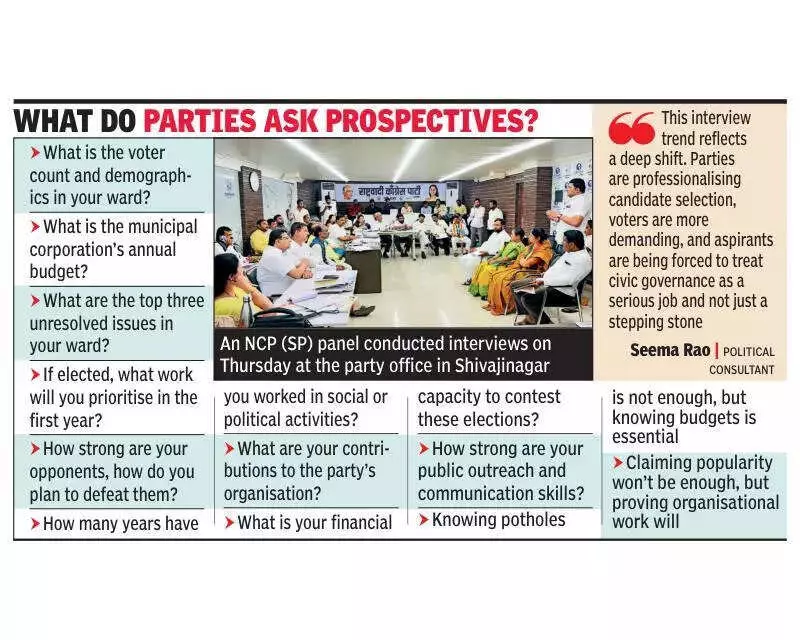
The typical questions asked in these interviews include:
- What is the voter count and demographic profile of your ward?
- What is the municipal corporation's annual budget?
- What are the top three unresolved issues in your ward?
- How strong is your opponent and what is your plan to defeat them?
- What are your contributions to the party's organisation?
This data-driven, performance-oriented approach signals that parties are responding to a more demanding electorate. Aspirants are now compelled to treat civic governance as a serious job requiring specific skills and knowledge, not merely as a symbolic or ceremonial stepping stone. The era of claiming popularity without proving organisational work or administrative understanding is rapidly fading in Pune's political landscape.





