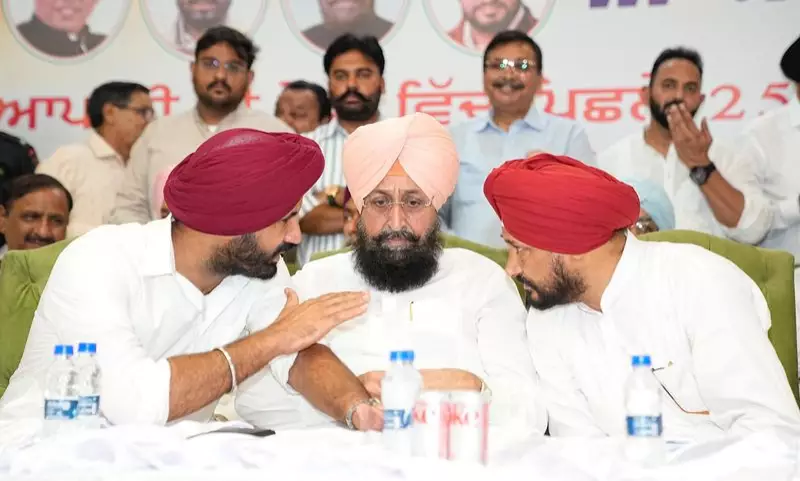
The Indian National Congress in Punjab stands at a critical juncture, with its high command initiating a significant organisational restructuring aimed at the 2026 Vidhan Sabha elections. This move is seen as a desperate attempt to unify a party deeply fractured by internal rivalries and a persistent leadership vacuum following its severe defeat in the 2022 state polls and the 2024 Lok Sabha elections.
The High Command's Intervention and Factional Fault Lines
According to senior party sources, the Congress high command, led by Mallikarjun Kharge and Rahul Gandhi, has begun a thorough assessment of the Punjab unit. The plan involves extensive consultations with state leaders to finalise a new organisational blueprint. The core objective is to forge a cohesive team capable of mounting a credible challenge in 2026.
However, this task is monumental, given the entrenched factionalism that plagues the state unit. The party remains sharply divided among camps loyal to former Chief Minister Charanjit Singh Channi, current state president Amarinder Singh Raja Warring, Leader of Opposition Partap Singh Bajwa, and former deputy chief minister Sukhjinder Singh Randhawa. This internal strife has repeatedly sabotaged party cohesion and public perception.
Sukhjinder Singh Randhawa, a prominent Jat leader, has been particularly vocal, alleging that a "coterie" within the Punjab Congress consistently undermines him and other senior figures. He has openly accused this group of misguiding the high command and creating an environment of distrust, which he claims is the primary reason for the party's electoral failures.
Leadership Crisis and Electoral Setbacks
The urgency for a revamp stems from consecutive electoral disasters. In the 2022 assembly elections, the Congress plummeted from 77 seats to just 18. The 2024 Lok Sabha results were even more devastating, with the party drawing a blank, losing all 13 seats. This outcome has intensified the blame game and exposed the complete failure of the existing state leadership.
Critics argue that the appointment of Amarinder Singh Raja Warring as Pradesh Congress Committee (PCC) chief and Partap Singh Bajwa as the Legislative Party leader has not yielded unity or electoral success. Instead, the parallel power centres and public spats between senior leaders have eroded the party's credibility. The high command's previous attempts to mediate, including sending observers like Bhakta Charan Das, have failed to produce a lasting solution.
The Road to 2026: Challenges and Imperatives
For the Congress to have any hope of revival in Punjab, the impending revamp must address several non-negotiable issues. First, it must decisively resolve the leadership question, establishing a clear and authoritative chain of command. Second, it needs to implement a social outreach strategy that reconnects with key voter bases, including Dalits, Hindus, and the trading community, whose support has significantly dwindled.
Furthermore, the party must craft a compelling political narrative against the ruling Aam Aadmi Party (AAP). Simply relying on anti-incumbency will not suffice. The new organisational structure will need to promote young talent while managing the ambitions of seasoned veterans, a balancing act that has proven difficult in the past.
The coming months are crucial. If the high command's revamp exercise is perceived as another superficial change or yields to pressure from one faction, it could sound the death knell for the party's prospects in 2026. The Punjab Congress revamp is not just an administrative exercise; it is a final opportunity for survival and relevance in a state where it was once the dominant political force.