

Punjab's Farmers Face Fragmentation Test as Protests Diversify Beyond MSP
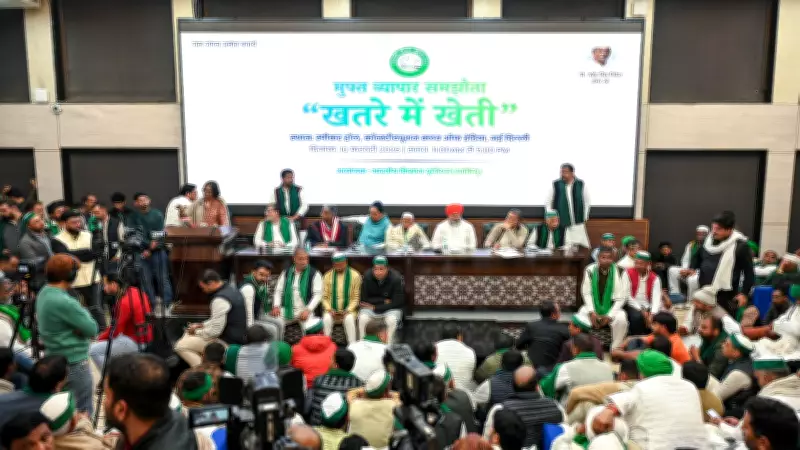
Once united in a historic movement, farmer unions in Punjab are now navigating a complex landscape of fragmentation, with protests widening beyond the core demand for Minimum Support Price (MSP). The current phase of agitation across India reveals a stark contrast to the unified resistance seen during the 2020-21 farm laws protest, as unions operate through divided platforms, potentially diluting their collective strength.
Fragmented Forums in Punjab
Punjab, which served as the epicenter of the nationwide farmers' uprising, now presents a fragmented picture. Farmer unions in the state are aligned with multiple forums, including the Samyukt Kisan Morcha (SKM), Kisan Mazdoor Morcha (KMM), and SKM (non-political), each announcing separate protest programs. This division marks a significant shift from the 2020-21 agitation, where deeply divided unions united under the SKM banner to successfully repeal three central farm laws.
Raminder Singh Patiala, general secretary of Kirti Kisan Union and a member of SKM's national coordination committee, acknowledged the challenges of fragmentation. "The February 12 general strike has the SKM's support, forming a large base of unions, but if all unions were united on one platform, we could press upon issues more effectively," he said. "SKM is always open for principal unity, as the issues before us are significant, beyond just the India-US trade deal."

Joint Struggles and Separate Paths
The SKM (non-political), led by farmer leader Jagjit Singh Dallewal, and KMM, coordinated by Sarwan Singh Pandher, previously collaborated on a prolonged agitation at the Shambhu and Khanauri borders from February 2024 to March 2025. This protest, lasting over 400 days, sought a legal guarantee for MSP but was forcibly lifted by the Punjab government. Since then, the two forums have not launched any joint agitation, despite the unmet core demand.
Dallewal expressed optimism about future unity, stating, "We have no issues with KMM. That was a joint agitation on an issue, and after that, both forums are doing their own programs. If needed, we can come on a common platform again. I am sure that if needed, we can come together again, as we did during the 2020–21 agitation." He added that fragmented protests on various issues, such as trade deals and labor codes, still impact governments, but a common platform could emerge if necessary.
State Response Hardens Amid Fragmentation
Recent incidents suggest that fragmented calls may be enabling governments to act more aggressively. On February 7, members of BKU Ugrahan were stopped from entering Bathinda city with police using tear gas and baton charges, detaining over 350 protesters. A BKU Ugrahan member noted anonymously, "It was one union's call, hence the government could dare to act tough. Otherwise, we have never seen such shelling by the Punjab government in its present tenure."
Similar situations occurred on December 5, 2025, when nearly 600 KMM members were detained ahead of a rail roko protest, and on January 18 in Majitha, where KMM members were prevented from reaching a rally. Sarwan Singh Pandher acknowledged the impact of fragmentation, saying, "A united platform can put pressure on the government to be answerable. We, as KMM, advocate principal unity."
MSP Slips into the Background
Amid multiple protests, the demand for a legal guarantee for MSP has receded from public discourse. A farmer union leader, speaking anonymously, explained, "The agitation for MSP lasted over 400 days, but today larger challenges are dominating the agenda." With SKM planning dharnas outside BJP and AAP leaders' homes on February 22—calls not supported by KMM and SKM (non-political)—the coming weeks may test whether unions can overcome divisions or continue parallel battles.

Parallel Government Charge and Expanding Roles
Farmer unions in Punjab are increasingly stepping into disputes beyond agrarian issues, such as land conflicts and family feuds, as villagers seek their support due to perceived weaknesses in formal mechanisms. Dallewal attributed this to political interference, stating, "When politicians and even the administration are unable to handle disputes fairly, villagers approach us, and we stand by them. There is a deliberate attempt by political forces to keep unions divided because unity gives farmers strength."
However, the state government views this activism critically. Chief Minister Bhagwant Mann has publicly criticized frequent protests, calling Punjab a "state of dharnas" and accusing some unions of creating anarchy by "running a parallel government." This tension underscores the broader challenges facing farmer unions as they navigate fragmentation and expanding roles in a crowded policy landscape.





