

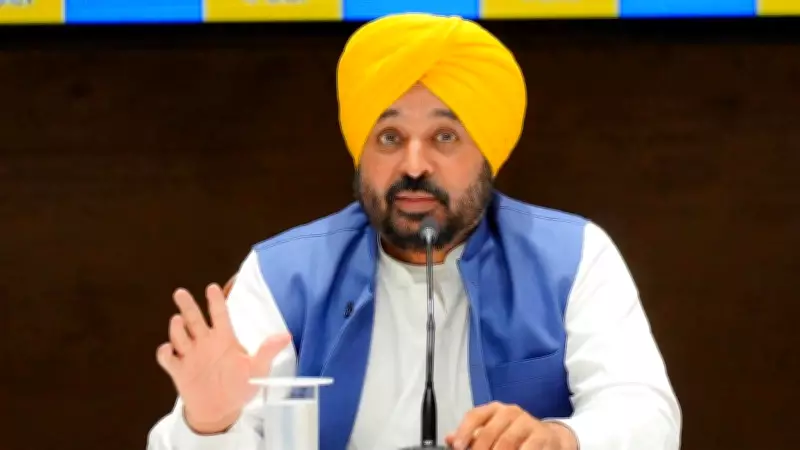
Punjab's Political Landscape: A Week of Reflections and Realignments
In the bustling corridors of power in Punjab, a series of candid admissions, political fallouts, and symbolic shifts are shaping the state's political narrative as it inches closer to the 2027 Assembly elections. From the Chief Minister's introspective moments to the dramatic exit of a once-key campaigner, the week has been rife with developments that underscore the complex interplay of satire, governance, and image politics.
Bhagwant Mann: From Satirist to Statesman, A Full Circle Journey
Punjab Chief Minister Bhagwant Mann struck a reflective note at the Mahinder Singh Randhawa Literature and Arts Festival, acknowledging that life has indeed come full circle for him. The satirist-turned-politician revealed that he often revisits his old cassettes, not for nostalgia, but as a cautionary tool. "I used to mock leaders," Mann confessed, emphasizing that listening to his past work helps him avoid the very mistakes he once lampooned.
His biggest lesson in politics, he stated, is straightforward: promise only what you can deliver. He recalled his satirical poem about elections in a jungle, where exaggerated promises reigned supreme, and contrasted it with today's reality where leaders can no longer say one thing in Samana and the opposite in Barnala without scrutiny. The irony is palpable, especially as his Aam Aadmi Party government grapples with fulfilling its flagship promise of Rs 1,000 per month to women, amid strained state finances. As Mann himself might have joked in his past life, satire is indeed easier than governance.

The Sidhu Saga: A Congress Gamble That Backfired
The relationship between Navjot Singh Sidhu and the Congress party has soured dramatically, culminating in a bitter fallout that many within the party saw coming. When Sidhu's wife, Navjot Kaur Sidhu, recently referred to AICC leader Rahul Gandhi as a "Pappu," Congress leaders did not bristle; instead, they quietly nodded in vindication. The roots of this discord trace back to 2017, when election strategist Prashant Kishor persuaded the Gandhis to bring Sidhu into the party fold, despite his dalliance with the Aam Aadmi Party.
The move initially paid off, with the Congress sweeping 77 seats in the Punjab Assembly elections, and Sidhu credited for adding color and decibels to the campaign. However, not everyone was convinced. Then Congress in-charge Asha Kumari dismissed the Sidhu couple as a "Tonga Party" and tried to block their entry, a warning that was brushed aside. Fast forward to 2022, and the Sidhus' support had turned lukewarm, with Charanjit Singh Channi as the chief ministerial candidate. Now, with an eye on 2027, Sidhu has accused the Congress of auctioning the chief minister's chair for Rs 500 crore, quit the party on social media, been expelled, and launched attacks on Rahul Gandhi. A senior Congress leader summed it up with a sigh: "Even the Opposition has stopped using the word 'Pappu'. It's sad, but somewhere, we feel vindicated, exactly after nine years."
Parkash Singh Badal's Prophetic Words and Majithia's Jail Terms
The late Parkash Singh Badal, the tallest Akali leader of his time, once made a blunt observation about political privilege within his own party. At an NRI Sammelan in Jalandhar in 2013, Badal, then chief minister, noted that he had gone to jail during his long political career, while leaders like Bikram Singh Majithia and Sukhbir Singh Badal had received everything "on a platter." This rare, unsparing admission from a man known for his careful words was seen more as a gentle rebuke than a warning at the time.
However, politics has a way of circling back. Since that remark, Majithia has been jailed twice—first during the tenure of Charanjit Singh Channi as chief minister, when Badal was still alive, and again after Badal's death. Majithia has now spent six months in jail since June, confronting a political and legal reality far removed from the privilege Badal once described. The Akali patriarch, though frail in his later years, lived to see privilege lose its aura of invincibility.

The Rise of Grey Beards and Royal Turbans: Symbolism in Punjab Politics
As the 2027 Punjab Assembly elections loom, a new dress code is emerging across party lines, with grey, flowing beards and neatly tied turbans becoming the norm. From Congress leaders like Pargat Singh and Balbir Sidhu to Rana Gurjit Singh, and BJP Rajya Sabha MP Satnam Singh Sandhu, the trend is unmistakable. Even Amarinder Singh Raja Warring, once known for shorn hair, began wearing a turban after taking over as state Congress chief.
The shift began earlier, with Shiromani Akali Dal chief Sukhbir Singh Badal among the first to adopt the grey, flowing beard. Bikram Singh Majithia, recently released on bail from Nabha jail, has joined the club. Before the 2022 Assembly elections, former deputy chief minister Sukhjinder Singh Randhawa had already experimented with the grey-beard look. Chief Minister Bhagwant Mann, too, transitioned from shorn hair to wearing a turban well before the 2017 elections, signaling a deliberate image shift. In a state where symbolism matters as much as slogans, even Haryana Chief Minister Nayab Singh Saini has joined the bandwagon, recently appearing in a saffron turban. In Punjab and its political neighborhood, image is increasingly part of the campaign script.
This week in Punjab politics has been a tapestry of introspection, realignment, and symbolism, setting the stage for a fiercely contested 2027 election. As leaders navigate the thin line between satire and governance, privilege and accountability, and image and substance, the corridors of power continue to buzz with anticipation and strategy.





