

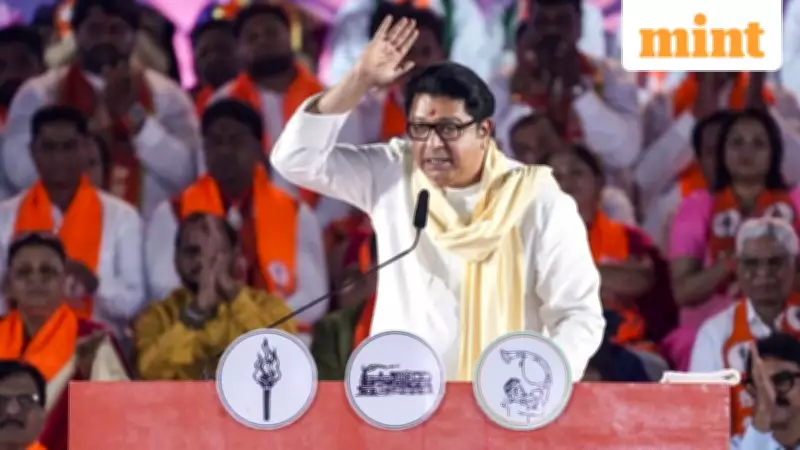
Political Storm Erupts in Maharashtra Over RSS Chief's Language Remarks
A significant political controversy has ignited in Maharashtra following comments made by Rashtriya Swayamsevak Sangh (RSS) chief Mohan Bhagwat regarding language-based agitations. During an event in Mumbai on February 8, Bhagwat reportedly described insistence on language and periodic protests over it as a 'kind of disease.' This characterization has drawn sharp criticism from regional political leaders, particularly Maharashtra Navnirman Sena (MNS) president Raj Thackeray.
Thackeray's Fiery Response Defends Linguistic Identity
Raj Thackeray launched a vigorous counterattack against Bhagwat's remarks, accusing the RSS leader of undermining the linguistic and regional identities that form the foundation of India's federal structure. In a statement issued on Tuesday, Thackeray asserted that if protesting for one's language is considered a disease, then a majority of Indian states suffer from this condition.
"If Bhagwat feels love for language and state is a disease, then a majority of the states in the country suffer from it," Thackeray declared, highlighting the deep-rooted regional sentiments across various states including Tamil Nadu, Karnataka, Punjab, West Bengal, and Gujarat.

Allegations of Coercion and Political Standoff
In a social media post, the MNS chief made further provocative claims regarding Bhagwat's recent Mumbai event, which was organized to mark the RSS centenary. Thackeray alleged that attendees participated not out of genuine affection for the RSS leader but rather from fear of the Narendra Modi-led government's influence.
Thackeray questioned Bhagwat's selective criticism, asking why similar 'sermons' weren't delivered to Gujarat when thousands of migrants from Uttar Pradesh and Bihar faced hostility there. He also challenged why lessons about harmony weren't directed toward other states with strong regional movements.
BJP's Counter-Argument and Defense of RSS
The Bharatiya Janata Party (BJP) swiftly responded to Thackeray's allegations, dismissing the notion that people attend RSS programs under duress. BJP state chief spokesperson Keshav Upadhye emphasized that participation in RSS activities occurs voluntarily and with discipline, reflecting the organization's century-long social acceptance.
Upadhye stated, "People participate in RSS shakhas, rallies and most events willingly and in an orderly manner." He contrasted this with what he described as the fading relevance of self-serving political parties like the MNS within just a few decades of existence.
Marathi Identity at the Heart of the Debate
The controversy has brought the issue of Marathi language and identity to the forefront of Maharashtra's political discourse. While the BJP acknowledged Marathi as a matter of pride, Upadhye stressed that any language should serve primarily as a medium of communication rather than conflict.
Thackeray, however, remained uncompromising in his defense of regional identity. "For us, the Marathi language and the Marathi people are of paramount priority," he affirmed, warning that Maharashtra would rise with 'full fury' whenever linguistic rights were threatened.
Broader Implications for Federal Politics
The exchange between Thackeray and Bhagwat touches upon fundamental questions about India's linguistic diversity and federal structure. Thackeray argued that when migrants from multiple states move to different regions, reject local culture, insult native languages, and create separate vote banks, it naturally breeds resentment among local populations.
The MNS leader also challenged Bhagwat on several other fronts:

- Questioning why the RSS chief hasn't spoken against what he called 'chaos in the name of Hindutva'
- Highlighting concerns about women's safety during religious processions
- Pointing to India's rising position in beef exports despite ongoing political controversies over cow slaughter
Historical Context and Recent Elections
This linguistic debate occurs against the backdrop of recent municipal corporation elections where both the MNS and Uddhav Thackeray's Shiv Sena (UBT) campaigned heavily on Marathi identity and 'sons of the soil' issues. Thackeray emphasized that his party has consistently taken stands on various community matters, including protests against the Raza Academy, opposition to mosque loudspeakers, and concerns about noise pollution during Hindu festivals.
The RSS, through Bhagwat's comments, appears to be advocating for a more unified approach to language, describing language-based conflicts as a 'localized disease' that shouldn't spread. However, regional leaders like Thackeray view this as an attack on the very foundations of India's diverse cultural fabric.
As the debate continues, it highlights the ongoing tension between national integration and regional identity in Indian politics, with Maharashtra serving as a crucial battleground for these competing visions of India's linguistic future.





