

Rajasthan Unveils Rs 6 Lakh Crore Budget with Core Focus on 'Bijli, Sadak, Paani'
In a significant move aimed at transforming the state, Rajasthan Deputy Chief Minister and Finance Minister Diya Kumari tabled the state budget for the fiscal year 2026-27 on Wednesday. The budget, valued at a staggering Rs 6,10,956 crore, underscores a continued emphasis on the fundamental pillars of 'bijli, sadak, paani' (electricity, roads, water), with a clear vision to achieve a developed Rajasthan by 2047.
Budget Highlights and Growth Projections
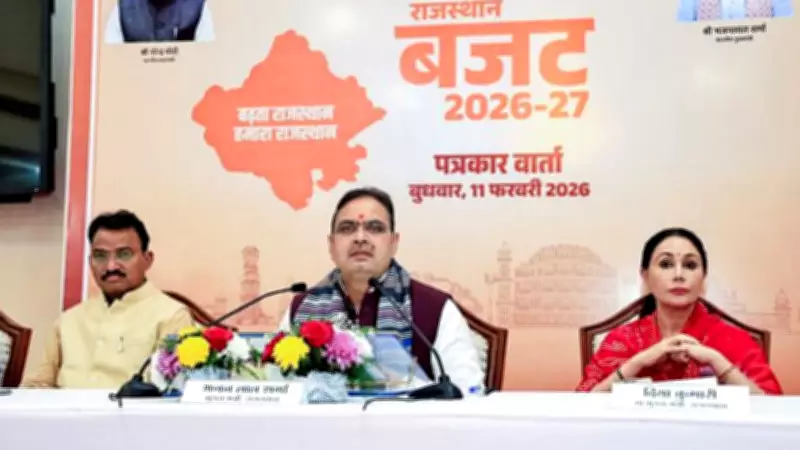
During the post-budget press conference in Jaipur, Chief Minister Bhajan Lal Sharma highlighted that this budget serves as an actionable plan aligned with the Vision 2047 document. He noted that the budget size has increased by over 41% compared to the 2023-24 fiscal year, the last under Congress rule. A key feature is the proposed capital expenditure of Rs 53,978 crore for infrastructure development, which is more than double the provision made during the previous administration.
Economic indicators show robust growth: the state's Gross State Domestic Product (GSDP) is projected to grow by 41.39% from the last year of the previous government, reaching Rs 21,52,100 crore. Additionally, per capita income is expected to rise to Rs 2,02,349 by the end of 2025-26, marking a 21.15% increase from 2023-24 and crossing the Rs 2 lakh threshold for the first time.

The government also reported high implementation rates: 93% of the 1,277 announcements from the 2024-25 budget and 86% of the 1,441 announcements from last year's budget have been executed on the ground.
Ten Pillars of the Budget
Finance Minister Diya Kumari outlined ten core pillars guiding the budget:
- Infrastructure expansion
- Improved civic amenities
- Industrial development and investment promotion
- Human resource development
- Strengthening social security
- Tourism, art, and cultural heritage
- Good governance and digital transformation
- Agriculture development and farmers' welfare
- Green growth and environmental sustainability
- Achieving a USD 4.3 trillion economy by 2047
Key Sectoral Allocations and Initiatives
Roads: To support the 2047 vision, priorities include strengthening road networks, eliminating level crossings, constructing bypasses, improving road safety black spots, expanding the Intelligent Transport System, and developing access roads for industrial areas.
Water: Over Rs 5,000 crore is allocated for drinking water infrastructure, targeting 6,245 peri-urban villages under the Jal Jeevan Mission (Urban). A second phase will improve water supply in 83 cities with Rs 2,530 crore, and 3 lakh drinking water connections will be issued under AMRUT 2.0.
Energy: Proposals include establishing six 220-kilovolt Grid Sub Stations, thirteen 132-kv GSS, and a 110 33-kv GSS. Solar Parks in Bikaner and Jaisalmer, with a capacity of 4,830 MW, will be developed through a joint venture at a cost of Rs 2,900 crore.
Civic Amenities: Rs 2,325 crore is earmarked for road works at divisional headquarters, including Rs 1,000 crore for Jaipur alone. Beautification, restoration, and upgradation projects across the state will cost approximately Rs 3,000 crore.
Industrial Development: Initiatives include land aggregation for industrial areas, Plug and Play facilities for small enterprises with Rs 350 crore, development of 3,600 hectares in the Jodhpur-Pali-Marwar area as part of the Delhi-Mumbai Industrial Corridor, and establishing an Inland Container Depot. Additionally, 14 new chapters of the Rajasthan Foundation and Rs 15 crore for micro and small units under the One District One Product Policy are proposed.
Human Resource Development: The Mukhyamantri Yuva Swarozgar Yojana offers interest subsidies on loans up to Rs 10 lakh for one lakh youth, with a Rs 1,000 crore outlay. Other programs include the Rajasthan State Testing Agency, VIBRANT for startups, Rani Laxmi Bai Centres in 150 colleges for self-defence training, DREAM for digital mentoring, and Raj-SAVERA to combat drug abuse.

Health: Goals by 2047 include universal health coverage, life expectancy over 77 years, reduced Maternal and Infant Mortality Rates, and a strong Emergency Response System. Schemes like RAJ-SURAKSHA for emergency treatment and Raj-MAMTA for mental health, including a Centre of Excellence in Jaipur, are introduced.
Social Security: Announcements feature a rural women BPO with Rs 100 crore, increased loan limits under schemes like lakhpati didi rinn yojana, Raj Sakhi Stores, and enhanced support for women entrepreneurs.
Tourism and Culture: Proposals include an Ultra luxury Special Tourism Zone in Khuri-Jaisalmer, an Advanced Braj Convention Centre in Bharatpur with Rs 100 crore, the Shekhawati Haveli Conservation Scheme for 660 havelis at Rs 200 crore, the Thar Cultural Circuit, and a War Museum in Jhunjhunu.
Farmers' Welfare: Over Rs 11,300 crore is allocated for irrigation, along with 50,000 solar pumps at Rs 1,500 crore, subsidies for agricultural equipment benefiting 50,000 farmers, and free Napier grass distribution. Interest-free crop loans worth Rs 25,000 crore for over 35 lakh farmers are also proposed.
Environmental Sustainability: Initiatives include planting 10 crore plants under 'Hariyalo Rajasthan', Namo-nurseries and Namo vans, Oxyzones in 16 districts with Rs 32 crore, Kumbha Biological Park at Chittorgarh with Rs 31 crore, and the PRITHWI Project for wildlife conservation with Rs 1,500 crore.
This comprehensive budget reflects Rajasthan's ambitious push towards sustainable development and economic growth, anchored in essential infrastructure and social welfare programs.





